
The State Council Press Office released a white paper on "Thirty Years of China’s Military Participation in UN Peacekeeping Operations" on the 18th. The full text is as follows:
China’s army has participated in UN peacekeeping operations for 30 years.
(September 2020)
People’s Republic of China (PRC)
the State Council Information Office
catalogue
foreword
1. China’s army went out for world peace.
Second, China’s army is a key force in United Nations peacekeeping operations.
(1) monitoring the ceasefire
(2) Stabilize the situation
(3) Protection of civilians
(4) Security guards
(5) Support guarantee
(6) Spreading hope
3. China fully implements the commitments of the UN peacekeeping summit.
(1) Complete the formation of peacekeeping standby forces.
(2) Send more security personnel to participate in UN peacekeeping operations.
(3) Complete the task of training peacekeepers for various countries.
(4) Providing gratis military assistance to the African Union.
(5) Send the first peacekeeping helicopter unit to carry out the task.
(6) Establish the China-United Nations Peace and Development Fund to support United Nations peacekeeping operations.
4. China’s army actively promotes international cooperation in peacekeeping.
(1) Strengthen strategic communication and build consensus on peacekeeping.
(2) Share experiences and practices and contribute to the wisdom of China.
(3) Deepen joint performance and joint training to jointly improve their abilities.
V. China’s military service builds a community of human destiny.
(1) uphold the concept of a community of human destiny and work together to safeguard world peace.
(2) Promote the improvement of the peacekeeping operation system, address both the symptoms and root causes of conflicts.
(3) Persist in discussing, building and complementing each other’s advantages to build a new peacekeeping partnership.
(4) Support the improvement of the Security Council’s peacekeeping mandate and comprehensively enhance the efficiency of peacekeeping operations.
(V) Give full play to the role of the capacity standby mechanism and improve the level of rapid response.
(6) Actively respond to various risk threats and effectively ensure the safety of peacekeepers.
Concluding remarks
Appendix 1 Memorabilia of China Army’s Participation in UN Peacekeeping Operations
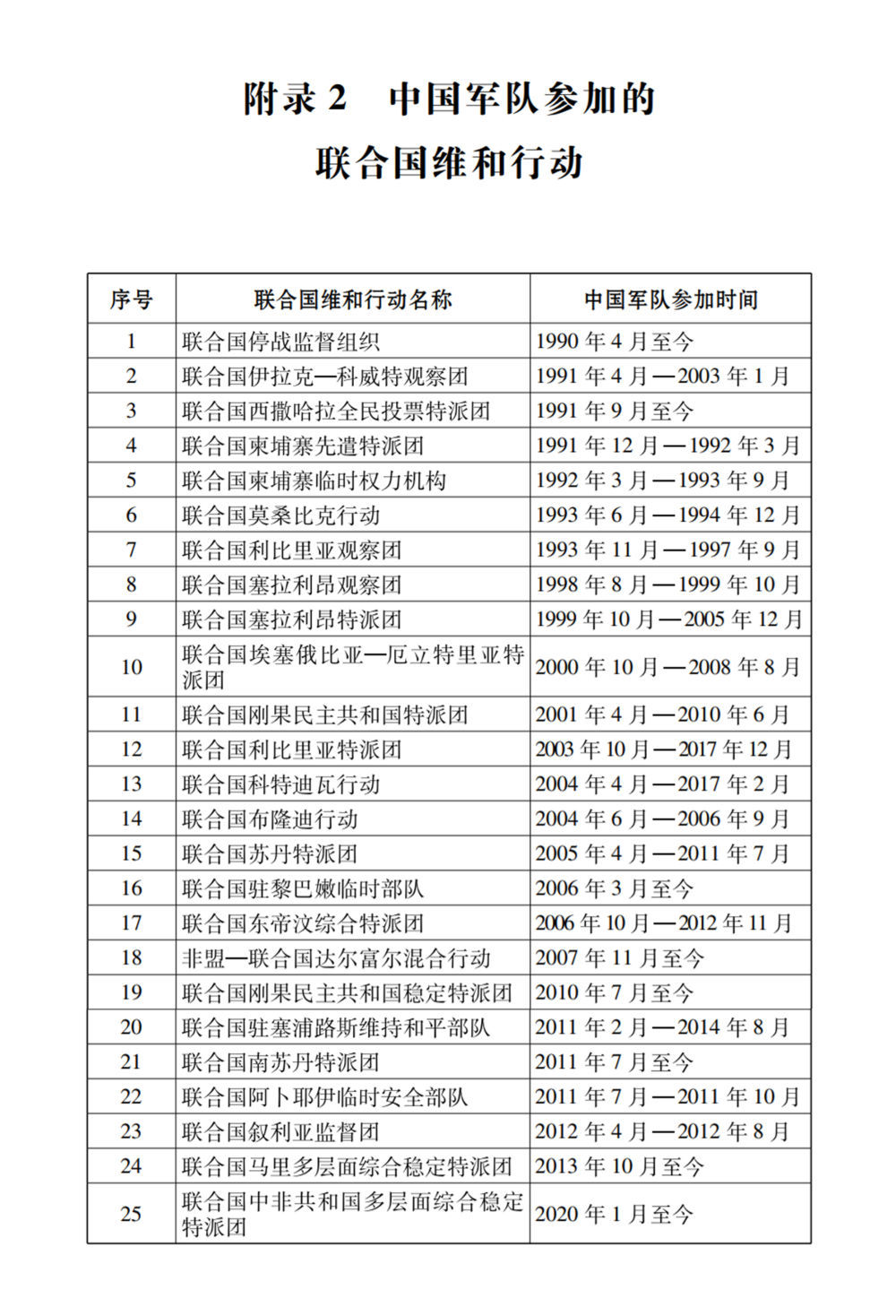
Appendix 2 United Nations Peacekeeping Operations Participated by China Army
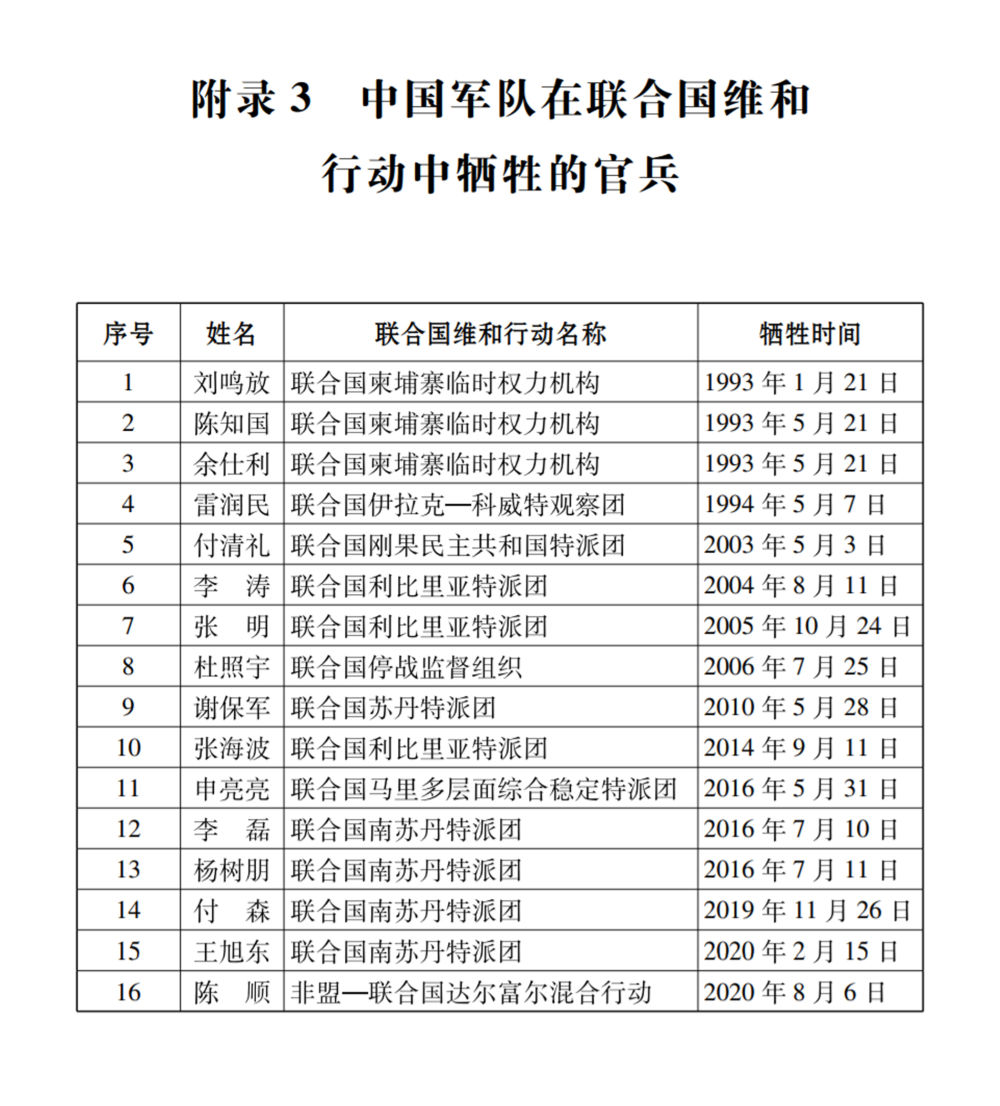
Appendix 3 Officers and men of China Army who died in United Nations peacekeeping operations
foreword
This year marks the 75th anniversary of the victory of Chinese citizen War of Resistance against Japanese Aggression and the world anti-fascist war, the 75th anniversary of the founding of the United Nations and the 30th anniversary of China’s participation in UN peacekeeping operations.
Peace is the eternal expectation of Chinese people and a distinctive feature of China’s development. Since the founding of New China, China has unswervingly followed the path of peaceful development, and has made important contributions to world peace and development while realizing self-development. China has always firmly upheld the international system with the United Nations at its core and the basic norms of international relations based on the purposes and principles of the Charter of the United Nations. Together with other countries, it has adhered to multilateralism and safeguarded fairness and justice.
China maintains world peace through practical actions and actively participates in UN peacekeeping operations. It is the second largest contributor to UN peacekeeping and the largest troop contributor as a permanent member of the Security Council. Over the past 30 years, China’s armed forces have earnestly implemented the purposes and principles of the UN Charter, participated in 25 UN peacekeeping operations successively, and sent more than 40,000 peacekeepers, faithfully fulfilling their peacekeeping missions, making positive contributions to safeguarding world peace and promoting common development, and showing their image as a teacher of peace, justice and civilization.
In the new era, China’s armed forces have fully implemented the commitments announced by the Supreme Leader Chairman when he attended the UN peacekeeping summit. With the goal of serving and building a community of human destiny, they have increased their support and participation in UN peacekeeping operations, bringing more confidence and hope to the peaceful development of conflict areas. China’s army in the new era has become a key factor and force in United Nations peacekeeping operations, injecting more positive energy into world peace and development.
The world today is experiencing a great change that has never happened in a hundred years. Peace and development are still the theme of the times, but they are facing increasingly severe and increasing risks and challenges. No matter how the international situation changes, China has always been a builder of world peace, a contributor to global development and a defender of international order, and China’s army has always been a just force for world peace and development.
Reviewing the glorious course of China’s army’s participation in UN peacekeeping operations for 30 years, and introducing the concept and actions of China’s army in maintaining world peace in the new era, the China government has issued this white paper.
1. China’s army went out for world peace.
United Nations peacekeeping operations are born for peace and exist for peace, and have made important contributions to the maintenance of world peace. In 1971, China resumed its legal seat in the United Nations and played a more active role in international affairs. After the reform and opening-up, China gradually participated in UN peacekeeping affairs. In April 1990, the China Army sent five military observers to the United Nations Truce Supervision Organization, which started the course of China Army’s participation in United Nations peacekeeping operations. Over the past 30 years, China’s army has always kept in mind its initial intention and mission of being a big country, maintaining world peace and serving to build a community of human destiny in United Nations peacekeeping operations, and fought bravely for world peace. China’s "Blue Helmets" have become the key force for the United Nations to maintain peace.
China’s participation in United Nations peacekeeping operations stems from the peaceful gene of the Chinese nation. The "harmony" culture of the Chinese nation contains the cosmology of harmony between man and nature, the international view of harmony among all nations, the social view of harmony but different, and the moral view of kindness among people. Peace, harmony and harmony are the simplest pursuits of the Chinese nation, and the concepts of harmony and symbiosis, valuing harmony and being kind to others have been passed down from generation to generation in China. For thousands of years, peace has been integrated into the blood of the Chinese nation and engraved into the genes of the people of China, which has become the unremitting pursuit of the China army.
China’s participation in United Nations peacekeeping operations stems from the feelings of the people of China. The people of China have always had the dream of "One World, One World", the mind of "A trip to the main road will serve the public", and the ambition of "worrying about the world first, and enjoying the world afterwards". They not only hope that they will have a good life, but also hope that the people of other countries will have a good life. China’s army went abroad, spreading hope and bringing peace.
China’s participation in United Nations peacekeeping operations stems from the fundamental purpose of the People’s Army. China’s army comes from the people, is rooted in the people, lives for the people and fights for the people. At all times and under all circumstances, it adheres to the fundamental purpose of serving the people wholeheartedly, shares the same fate with the people, and puts the interests of the people first. Chinese peacekeepers cherishes the great love of the world, upholds the humanitarian spirit, and strives for peace and happiness for the local people.
China’s participation in United Nations peacekeeping operations originated from China’s role as a big country. China is a founding member of the United Nations. It is China’s due duty as a responsible member of the international community to firmly safeguard the authority and status of the United Nations and actively participate in United Nations peacekeeping operations. As a permanent member of the UN Security Council, China actively participates in UN peacekeeping operations, which is China’s due responsibility to fulfill its responsibilities as a big country. World peace is inseparable, and the destiny of mankind is shared by all. Actively participating in United Nations peacekeeping operations is the proper meaning for China to join hands with other countries to build a community of human destiny.
China’s army participates in United Nations peacekeeping operations and upholds the following policy positions:
— — Adhere to the purposes and principles of the UN Charter. Always adhere to the main principles of the United Nations, such as the sovereign equality of all Member States and the peaceful settlement of international disputes, respect the social system and development path independently chosen by each country, and respect and accommodate the legitimate security concerns of all parties.
— — Adhere to the basic principles of un peacekeeping operations. Always adhere to the basic principles of consent, neutrality, non-self-defense or non-use of force when performing authorization, respect the territorial integrity and political independence of sovereign countries, maintain a fair position, and accurately implement the authorization of the Security Council.
— — Adhere to the global governance concept of discussing, building and sharing. Always adhere to dialogue and consultation to build a world of lasting peace; Insist on co-construction and sharing to build a universally safe world; Adhere to win-win cooperation and build a world of common prosperity; Adhere to exchanges and mutual learning to build an open and inclusive world; Adhere to green and low carbon, and build a clean and beautiful world.
— — Adhere to the new security concept of common, comprehensive, cooperative and sustainable. We will always respect and safeguard the security of every country, maintain the security in traditional and non-traditional fields as a whole, promote the security of countries and regions through dialogue and cooperation, and pay equal attention to development and security in order to achieve lasting security.
— — Insist on resolving disputes by peaceful means. We will always persist in resolving differences and disputes between countries and within countries by peaceful means, enhance mutual trust through dialogue, resolve disputes through dialogue, promote security through dialogue, and resolutely oppose resorting to or threatening to use force at will.
— — Insist on building a strong peacekeeping partnership. We will always adhere to the reform of peacekeeping operations, mobilize the enthusiasm of the countries concerned, troop-contributing countries and capital-contributing countries, give full play to the role of regional and subregional organizations, and promote the establishment of a closer partnership in the field of peacekeeping operations.
Second, China’s army is a key force in United Nations peacekeeping operations.
Over the past 30 years, the number and types of peacekeeping officers and soldiers sent by the China Army have developed in an all-round way, from the initial military observers to formed units such as engineering units, medical units, transport units, helicopter units, security units and infantry battalions, as well as peacekeeping military professionals such as staff officers, military observers and contract officers. China’s peacekeepers have traveled all over more than 20 countries and regions, including Cambodia, Democratic Republic of the Congo, Liberia, Sudan, Lebanon, Cyprus, South Sudan, Mali and Central Africa, and have made important contributions to promoting peaceful settlement of disputes, maintaining regional security and stability, and promoting economic and social development in host countries.
(1) monitoring the ceasefire
Monitoring the ceasefire is aimed at ensuring that all parties to the conflict fulfill the ceasefire agreement. It is the initial function of the United Nations peacekeeping operation and the first UN peacekeeping mission undertaken by the China army. Since 1990, the contingent of peacekeeping military professionals in China, represented by military observers, staff officers and contract officers, has been growing. Over the past 30 years, the China Army has sent 2,064 peacekeeping military professionals to 25 peacekeeping missions and United Nations Headquarters. Up to now, 13 China soldiers have held important positions such as commander and deputy commander of the mission, commander and deputy commander of the theater. In August 2020, 84 peacekeeping military professionals were active in peacekeeping missions and United Nations Headquarters, mainly responsible for patrol observation, ceasefire monitoring, liaison and negotiation, operational command, organizational planning and other tasks.
Military observers are deployed in the front line of conflicts and provide information for decision-making of peacekeeping operations, and are often threatened by armed conflicts. On July 25th, 2006, during his stay in lebanon war, Du Zhaoyu, a military observer from China, stuck to his post and performed his duties under fire. He gave his young life for the cause of peace, was awarded the first-class merit, and was awarded the Hammarskjö ld Medal by the United Nations.
(2) Stabilize the situation
Rapidly stabilizing the situation is a prerequisite for advancing the peace process, the main task of the United Nations peacekeeping mission, and an important direction for chinese peacekeepers to expand its functions in recent years. The security situation in some peacekeeping mission areas is grim, with constant conflicts, frequent terrorist attacks and violent riots. Among all kinds of peacekeeping units, the infantry battalion mainly performs tasks such as armed patrol, conflict isolation, riot control and alert search, and is the main force of peacekeeping operations and the "stabilizer" of the security situation.
In January 2015, the Sudanese army dispatched a 700-man infantry battalion to the United Nations Mission in South China (UNMISS), which was the first time that the China army sent an infantry battalion overseas to carry out peacekeeping missions. Over the past five years, China’s army has sent six peacekeeping infantry battalions to South Sudan. It is a true portrayal of the work and life of the officers and men of the peacekeeping infantry battalion to set out against the sunrise and return to camp under the starlight, fall asleep and wake up in the gunfire. By August 2020, the peacekeeping infantry battalion had completed 51 long-distance patrols, 93 short-distance patrols, 314 armed escort missions and patrolled the restricted weapons area for more than 30,000 hours, which played an important role in stabilizing the local situation. In August 2018, a large-scale fighting and bloodshed occurred in Juba, the capital of South Sudan. China’s peacekeeping infantry battalion was ordered to attack, deal with it decisively and quickly calm down the situation.
(3) Protection of civilians
Protecting civilians is an important part of United Nations peacekeeping operations, and it is also the unshirkable responsibility and unswerving choice of China peacekeepers. In modern times, the people of China have suffered from war, and China officers and men know that peace is precious and life is priceless. In the war-torn peacekeeping mission area, China peacekeepers watered the beautiful flowers of peace with sweat and youth, and propped up a peaceful blue sky with blood and life.
In July 2016, an armed conflict broke out in Juba, the capital of South Sudan. The government forces and anti-government forces continued to fight fiercely. The two sides invested in heavy weapons such as tanks, large-caliber artillery and helicopter gunships, and the lives of a large number of civilians in the crossfire area were seriously threatened. China Peacekeeping Infantry Battalion and its neighboring troops jointly undertake the task of protecting the safety of civilians in Juba city and more than 100 villages in its suburbs. In the face of bullets, China peacekeepers used their flesh and blood to build a "life defense line" to prevent militants from approaching the civilian protection zone, thus protecting the lives of more than 9,000 civilians. During the mission, two soldiers, Li Lei and Yang Shupeng, sacrificed heroically, fulfilled their mission with their lives, bravely and fearlessly carried out the clang oath of protecting life and defending peace, and were awarded the Hammarskjö ld Medal by the United Nations.
(4) Security guards
Security guard is an important task to ensure the safety of facilities and personnel in United Nations missions. As an important participant in United Nations peacekeeping operations, China Army has actively sent peacekeeping security forces to provide strong security for United Nations peacekeeping operations.
In December 2013, the China Army sent a 170-member security detachment to the United Nations Multidimensional Integrated Stabilization Mission in Mali (MINUSMA) to undertake the tasks of security alert and VIP escort of the East Theater Command of MINUSMA. This was the first time that the China Army sent security forces to participate in peacekeeping operations. Mali is one of the most dangerous peacekeeping mission areas of the United Nations, and terrorist attacks such as suicide attacks and roadside bombs occur frequently. Over the past seven years, China’s army has sent eight groups of guard units and 1,440 officers and men to the Mali peacekeeping mission area. On the southern edge of the crisis-ridden Sahara desert, the officers and men of the guard units have accomplished their tasks brilliantly, and have carried out armed patrols, guard guards and other actions for more than 3,900 times, which has been praised as "the trump card of the war zone" by the East War Zone of UMTU. On May 31, 2016, Shen Liangliang, a China peacekeeper, died heroically to prevent a terrorist vehicle carrying explosives from rushing into the United Nations peacekeeping camp. He was awarded the Hammarskjö ld Medal by the United Nations. On the occasion of the 70th anniversary of the founding of People’s Republic of China (PRC), Shen Liangliang Martyrs were awarded the honorary title of "People’s Heroes".
On March 12, 2017, a fierce conflict broke out in Yei, a border town in South Sudan. Seven United Nations civilian personnel were trapped in the center of the crossfire area, and their lives were seriously threatened. China’s peacekeeping infantry battalion in South Sudan rushed to send 12 officers and men to the rescue. During the journey, the dangers continued, and the rescue officers and soldiers were not afraid of danger. They fought bravely with the militants and broke through the interception for three times, successfully transferring all the trapped civilians safely. The rescue operation was timely and efficient, and was promoted by the United South Soviet Union as a successful example of rescue operation.
(5) Support guarantee
Logistics support units such as engineering, transportation, medical care and helicopters play an indispensable role in UN peacekeeping operations, and are the main body of China’s current peacekeeping troops sent overseas. In each peacekeeping mission area, the officers and men of China Logistics Support Unit have created shining China brands such as "China Quality", "China Speed" and "China Standard" with excellent quality, exquisite skills and professionalism.
In January, 2020, terrorist attacks were carried out on Tessalitvi and Camp in the Northern Theater of the United Youth League, causing more than 20 injuries. The China medical unit deployed in the East War Zone rushed out to take seven wounded Chadian peacekeepers back to the China medical unit. After all-out rescue, all the wounded turned to safety. In May 2020, China’s peacekeeping engineering detachment overcame the unfavorable factors such as the pressure of COVID-19 epidemic prevention and control and the severe security situation, completed the construction of the Thorpe Bridge in western South Sudan with high standards and high quality, and opened the Wau-LAC line, which won high praise and praise from the local government and people.
Over the past 30 years, China’s army has dispatched 111 engineering detachments to eight peacekeeping mission areas, including Cambodia, Democratic Republic of the Congo, Liberia, Sudan, Lebanon, Darfur, South Sudan and Mali, with 25,768 person-times. It has built and repaired more than 17,000 kilometers of roads and more than 300 bridges, cleared more than 14,000 mines and unexploded ordnance, and completed a large number of site leveling, airport maintenance, board houses and fortifications. It has dispatched 27 transport detachments to Liberia and Sudan for 5,164 person-times, transporting more than 1.2 million tons of materials and equipment, with a total transportation mileage of more than 13 million kilometers. It has sent 4,259 person-times of 85 medical teams to six mission areas in the Democratic Republic of the Congo, Liberia, Sudan, Lebanon, South Sudan and Mali, and has received more than 246,000 patients and rescued the wounded. Three helicopter units were dispatched to Darfur, Sudan for 420 person-times, with a total of 1,602 flights and 1,951 hours, and 10,410 people were transported and more than 480 tons of materials were delivered.
(6) Spreading hope
Living a happy and beautiful life is the common expectation of people of all countries. China’s peacekeepers who have gone overseas have brought peace and lit up hope for the people devastated by war with practical actions.
Actively assist in humanitarian relief. Over the past 30 years, chinese peacekeepers has joined hands with international humanitarian agencies, actively participated in refugee resettlement, relief food distribution, refugee camp construction, emergency rescue and disaster relief, and carried out a lot of fruitful work. In April, 2020, a rare flood broke out in Uvira, eastern Democratic Republic of Congo, which seriously threatened the safety of people’s lives and property. China’s engineering unit was ordered to reinforce dams, repair damaged bridges and open life passages, thus effectively protecting the safety of local people.
Extensive participation in post-war reconstruction. After a war-torn country or region has signed a peace agreement, helping it to restore social order and improve people’s livelihood is the fundamental policy to prevent the recurrence of conflicts and achieve lasting peace and stability. Chinese peacekeepers actively participated in the post-war reconstruction process in the host country, and undertook the tasks of building important infrastructure, assisting in supervising elections, training medical personnel and protecting the environment, which was positively evaluated by the governments and people in the host country. Located on the edge of the desert and with complex geological structure, Darfur is one of the areas with extremely poor water supply in the world. During 2007-2013, the water supply officers and soldiers of China engineering detachment overcame many difficulties and successively drilled 14 wells in the area, effectively alleviating the drinking water problem of local people.
Pass on warmth and love. China peacekeepers are not only guardians of peace, but also disseminators of friendship. China’s medical team in Congo (DRC) paired with the resident "International Children’s Village" in Bukavu to convey love and warmth with true feelings. The female officers and men in China were affectionately called "Chinese mothers" by the children. This love baton has been continued for 17 years, and it has become a much-told story in the local area. China’s peacekeeping troops in South Sudan taught the local people agricultural technology, donated farm tools and vegetables, and was invited to offer courses on China culture and Chinese in local middle schools, which was well received by the students.
Over the past 30 years, China’s army has participated in 25 UN peacekeeping operations, sending more than 40,000 peacekeepers, and 16 China officers and men have given their lives for the cause of peace. In August, 2020, 2,521 officers and men from China were on duty in eight peacekeeping missions and United Nations Headquarters. China’s female peacekeeping officers and soldiers have played an increasingly important role in peacekeeping operations. More than 1,000 female officers and soldiers have participated in medical security, liaison and coordination, mine clearance and explosion disposal, patrol observation, promotion of gender equality, protection of women and children, and so on, showing the elegant demeanor of women in China. Chinese peacekeepers’s outstanding performance has been highly recognized by the United Nations, widely appreciated by the international community, and won honor for the country and the army. On October 1, 2019, the chinese peacekeepers team was reviewed by the motherland and the people for the first time in the National Day military parade.
3. China fully implements the commitments of the UN peacekeeping summit.
On September 28th, 2015, the Supreme Leader of president, China attended the UN Peacekeeping Summit and announced six commitments to support UN peacekeeping operations. China’s government and army have resolutely implemented the decision-making arrangements of the Supreme Leader, kept their words and carried out their deeds, fulfilled their relevant commitments with practical actions, and achieved a series of important results. In the past five years, the composition of chinese peacekeepers has expanded from single service to multi-service, the task type has changed from support to comprehensive multi-function, the action goal has extended from stopping armed conflict to building lasting peace, and the peacekeeping capability has been further improved.
(1) Complete the formation of peacekeeping standby forces.
The rapid deployment of peacekeeping operations can win opportunities for peace and time for life. China’s army strongly supports the construction of the standby mechanism of United Nations peacekeeping capacity and enhances the rapid deployment capability of peacekeeping operations. In September 2017, the 8,000-person peacekeeping standby force was registered in the United Nations, including 28 detachments of 10 professional forces including infantry, engineers, transportation, medical care, guards, quick reaction, helicopters, transport planes, drones and surface ships. In October 2018, 13 peacekeeping standby units were promoted to secondary standby units through inspection and evaluation organized by the United Nations. From 2019 to 2020, six peacekeeping standby units were promoted from the second level to the third level. China’s peacekeeping standby force is a well-trained, well-equipped and disciplined professional force with strict training in accordance with United Nations standards and always on standby. China has become the country with the largest number of United Nations peacekeeping standby forces and the most complete types of units. In addition, the Ministry of Public Security of China took the lead in setting up the world’s first established standing peacekeeping police force in June 2016, which was promoted to rapid deployment level in October 2019.
(2) Send more security personnel to participate in UN peacekeeping operations.
Logistics support forces such as engineering, transportation and medical care are important supports for peacekeeping operations, which not only effectively improve the performance efficiency of missions, but also play an important role in post-war reconstruction and improvement of people’s livelihood in host countries. China’s army has the tradition and advantage of sending support teams to participate in peacekeeping operations. Since the UN peacekeeping summit in 2015, China’s army has actively responded to the demand of UN peacekeeping operations in terms of engineering support and medical treatment. It has sent 25 batches of peacekeeping engineers and medical teams with a total of 7,001 people to participate in peacekeeping operations in the Democratic Republic of the Congo, South Sudan, Darfur, Mali and Lebanon. In August, 2020, China Army had 6 engineering detachments with 1,188 people and 4 medical detachments with 199 people who were carrying out UN peacekeeping missions. They built roads and bridges, cleared mines and defused explosives, saved lives and helped rebuild in dangerous, turbulent and difficult environment, successfully completed various tasks entrusted by the United Nations, made positive contributions to the local peace process, and set up a good image of the United Nations peacekeeping force.
(3) Complete the task of training peacekeepers for various countries.
Adhering to the spirit of resource sharing and win-win cooperation, China’s army has actively helped other troop-contributing countries to improve their training level, enhance their ability to cope with complex environments and better carry out United Nations peacekeeping missions. Over the past five years, 20 batches of professional training have been held for the protection of civilians, senior officials of peacekeeping missions, peacekeeping instructors, peacekeeping military professionals and female peacekeeping officers, and more than 1,500 peacekeepers have been trained for more than 60 countries. China’s army has carried out demining assistance projects and trained more than 300 deminers for Cambodia, Laos, Ethiopia, Sudan, Zambia and Zimbabwe. In addition, the Ministry of Public Security of China has trained more than 1,000 multinational peacekeeping police officers.
(4) Providing gratis military assistance to the African Union.
The main demand for peacekeeping operations is in Africa. In order to support African countries to improve their peacekeeping and stability, and solve African problems in an African way, China’s army has actively implemented US$ 100 million in unpaid military assistance to the African Union, and supported the construction of an African standing army and a rapid response force for crisis response. So far, China’s army has delivered the first batch of military aid equipment and materials to the African Union, sent military experts to train non-party personnel, and reached an agreement with the African Union on the next stage of military aid arrangements.
(5) Send the first peacekeeping helicopter unit to carry out the task.
China and Hawk soar for peace. In August, 2017, the China Army sent its first helicopter unit of 140 people to the African Union-United Nations Hybrid Operation in Darfur (UNAMID) and deployed four medium-sized multi-purpose helicopters, which were mainly responsible for troop delivery, operational support, personnel search and rescue evacuation, logistics supply and other tasks. China’s peacekeeping helicopter unit has completed many high-risk missions in unfamiliar and complex overseas environments, and has become an important military aviation force of the African Union Mission, providing important support for the United Nations peacekeeping operations in Darfur.
(6) Establish the China-United Nations Peace and Development Fund to support United Nations peacekeeping operations.
In order to better support the United Nations peace cause and promote multilateral cooperation, China established the China-United Nations Peace and Development Fund. From 2016 to 2019, the China-United Nations Peace and Development Fund carried out 52 projects in the field of peace and security, with a capital of about 33.62 million US dollars. Among them, 23 projects involve supporting UN peacekeeping operations, and the funds used are about 10.38 million US dollars, including the overall planning of UN peacekeeping operations, the building of African peacekeeping capacity, the security of peacekeepers, and livelihood projects in peacekeeping operations such as Darfur and Mali in Sudan.
4. China’s army actively promotes international cooperation in peacekeeping.
World peace needs to be jointly maintained by all countries, and peacekeeping operations need to strengthen cooperation among various parties. China’s armed forces have successively carried out peacekeeping exchanges and cooperation with more than 90 countries and more than 10 international and regional organizations, enhanced mutual understanding, exchanged experiences and practices, strengthened pragmatic cooperation, and strengthened bilateral and multilateral relations through group visits, expert exchanges, joint performances and personnel training, and continuously improved their peacekeeping capabilities.
(1) Strengthen strategic communication and build consensus on peacekeeping.
Strengthening strategic communication with the top level of the United Nations is an important way for the development of United Nations peacekeeping operations. Since 2012, the Chairman of the Supreme Leader has met with the Secretary-General of the United Nations for 11 times, put forward China’s proposal and China’s plan on world peace and development on many international occasions, and expressed his support for UN peacekeeping operations. In 2015, the Chairman of the Supreme Leader attended the United Nations peacekeeping summit, and put forward ideas such as adhering to the basic principles of peacekeeping, improving the peacekeeping operation system, improving the level of rapid response, and increasing assistance to Africa. China’s armed forces resolutely implemented the consensus reached by the leaders, strengthened close communication with relevant UN agencies, participated in UN peacekeeping ministerial meetings and UN peacekeeping troop-contributing countries’ chiefs of staff meetings for many times, and actively promoted cooperation in peacekeeping.
Strengthen bilateral and multilateral communication and enhance mutual understanding and trust. China’s army has actively exchanged visits with Russian, Pakistani, Cambodian, Indonesian, Vietnamese, French, German, British, American and other countries in the field of peacekeeping, strengthened policy communication, planned peacekeeping cooperation, and promoted the development of friendly relations between the two countries and their armed forces. In May 2010, the first Sino-US consultation on peacekeeping affairs was held in Beijing. In April 2015, the defense ministers of China and Viet Nam signed a memorandum of cooperation in the field of peacekeeping between the two defense ministries in Beijing; In the same year, China held the first BRICS peacekeeping consultation with Brazil, Russia, India and South Africa. In February 2017, the first Sino-British consultation on peacekeeping affairs was held in the UK. In April 2018, Russian, French, British and American military representatives of the United Nations Military Staff Committee visited China and had extensive exchanges with China on peacekeeping operations. In May, China and Pakistan signed a protocol on policy cooperation in peacekeeping operations; In October, the German Defense Minister visited the training base of the Peacekeeping Affairs Center of the Ministry of National Defense of China, and the peacekeeping delegation of the Ministry of National Defense of China visited the United Nations Center of the German Defence Force.
(2) Share experiences and practices and contribute to the wisdom of China.
Learning from each other and exchanging experiences are effective ways to improve United Nations peacekeeping operations. China’s army actively carried out international exchanges in the field of peacekeeping, and sent peacekeeping professional delegations to visit Argentine, Finnish, German and other military peacekeeping training institutions. More than 180 visits by delegations from various countries and international organizations such as the United Nations and the African Union. More than 10 large-scale international peacekeeping seminars were held, such as Sino-British peacekeeping seminar, international seminar on challenges to peace operations in the 21st century, China-ASEAN peacekeeping seminar and 2009 Beijing International Peacekeeping Seminar. Chinese peacekeepers in Mali, Sudan, South Sudan, Democratic Republic of the Congo, Liberia and Lebanon exchanged experiences and practices with French, Senegalese and Spanish peacekeeping forces.
China’s army has extensively participated in UN peacekeeping deliberations and policy formulation, contributing wisdom to the development of peacekeeping operations. Actively participate in the UN General Assembly’s peacekeeping special committee and troop-contributing countries’ self-brought equipment meeting, invite the UN peacekeeping high-level review expert group and the Security Council delegation to visit China, and make suggestions on the reform of UN peacekeeping operations, improve the efficiency of peacekeeping operations, and ensure the safety of peacekeepers; Organize international conferences on expert editing and editing such as the Handbook of United Nations Peacekeeping Engineering Units and the Handbook of United Nations Peacekeeping Military Intelligence, and send experts to participate in the compilation and revision of United Nations peacekeeping instruction manuals such as infantry, security, aviation, transportation, medical service and civil-military cooperation.
(3) Deepen joint performance and joint training to jointly improve their abilities.
Carrying out joint performance and training in the field of peacekeeping is an important measure to improve the mission ability of carrying out UN peacekeeping operations and cultivate reserve peacekeeping talents. Through various forms, China’s army conducts peacekeeping training activities with the United Nations and relevant countries and regional organizations, learning from each other and improving together. From June to July, 2009, China and Mongolia held "Peacekeeping Mission-2009" joint training in Beijing. In February 2014, he sent personnel to the Philippines to participate in the desktop deduction of ASEAN 10+8 multinational peacekeeping; From 2015 to 2019, we sent troops to Mongolia every year to participate in the "Khan Exploration" multinational peacekeeping exercise; In March 2016 and September 2019, we sent troops to India and Indonesia to participate in the ASEAN 10+8 peacekeeping and humanitarian demining joint exercise; In May 2016 and May 2018, he sent personnel to Thailand twice to participate in multinational peacekeeping desktop deduction; In April 2018, he sent staff to Brazil to participate in the deduction of the "Viking" multinational simulation command post.
Since the establishment of the peacekeeping professional training institution by the China Army in June 2009, it has held more than 20 international training courses for United Nations military observers, United Nations peacekeeping staff officers, United Nations peacekeeping instructors in French-speaking Africa, and planning and management of United Nations peacekeeping operations. Actively invite United Nations experts and senior instructors from relevant countries to teach and exchange in China, and strengthen the pre-deployment training of peacekeeping troops and peacekeeping military professionals. Peacekeeping instructors have been sent to peacekeeping training institutions in Australia, Germany, the Netherlands, Switzerland, Thailand, Vietnam and other countries for training, and more than 100 officers have been sent to participate in peacekeeping training or observation organized by the United Nations and troop-contributing countries.
V. China’s military service builds a community of human destiny.
Today, the world is experiencing a great change that has never happened in a century. The global epidemic of COVID-19 epidemic has accelerated this great change, and the instability and uncertainty of the international security situation have increased, and world peace is facing multiple threats. The United Nations peacekeeping operations are facing increasing constraints, increasingly heavy functions and tasks, increasingly complex security environment and multiple challenges and tests. China will continue to play the role of a permanent member of the Security Council, firmly support and participate in UN peacekeeping operations, actively respond to the UN’s "Action for Peacekeeping" initiative, support reasonable and necessary reform of UN peacekeeping operations, and make due contributions to building a world of lasting peace, universal security, common prosperity, openness, tolerance, cleanliness and beauty.
(1) uphold the concept of a community of human destiny and work together to safeguard world peace.
In today’s world, people in conflict areas are still suffering from war, and their desire for peace is stronger, their expectations for the United Nations are more ardent, and their expectations for peacekeeping operations are more urgent. All countries should respect each other, treat each other as equals, persist in solving contradictions and problems through dialogue and consultation with the utmost sincerity and patience, and should not resort to force or threat of force at will to undermine world peace and harm the interests of sovereign countries. All countries should enhance the sense of community of human destiny, carry forward the humanitarian spirit, and more firmly support and actively participate in United Nations peacekeeping operations. China will continue to fulfill its responsibilities as a big country, increase its support for UN peacekeeping operations, and work with other countries to promote the reform of UN peacekeeping operations in a healthy and reasonable direction. China’s army will continue to increase its participation in United Nations peacekeeping operations, enhance its peacekeeping capability in an all-round way, faithfully perform its mission and make greater contributions to the maintenance of world peace.
(2) Promote the improvement of the peacekeeping operation system, address both the symptoms and root causes of conflicts.
Pay equal attention to development and security, address both the symptoms and root causes of conflicts, and peace can be sustainable. Peacekeeping operations should not only be vertically linked with preventive diplomacy and peace maintenance, but also be horizontally coordinated with political mediation, promoting the rule of law, national reconciliation and improving people’s livelihood. China supports the United Nations to build a more perfect peacekeeping operation system. While focusing on the fundamental tasks of peacekeeping operations, it will devote more limited resources to development, fully respect the right of the governments concerned to choose their own social systems and development paths according to their national conditions, and respect the people’s rights to subsistence and development, so that the countries concerned can concentrate on development and reconstruction, consolidate the achievements of peace and achieve sustainable peace. In peacekeeping operations, the China Army will, as always, create a safe and stable environment for countries and regions in conflict, actively participate in medical and health care, humanitarian relief, environmental protection, people’s livelihood development and social reconstruction, provide more public service products, and strive to make local people enjoy the dividend of peaceful development.
(3) Persist in discussing, building and complementing each other’s advantages to build a new peacekeeping partnership.
Troop-contributing countries and capital-contributing countries are important contributors to peacekeeping operations. All countries should shoulder their due responsibilities in the field of peacekeeping, complement each other’s advantages and form a joint force in accordance with the principle of joint construction. China supports the United Nations to actively build a peacekeeping partnership, strengthen the coordination of the Security Council and the Secretariat with troop-contributing countries and countries concerned in peacekeeping operations, and strengthen the division of labor and cooperation with regional and subregional organizations in peacekeeping. China’s army will actively respond to the tripartite cooperation mechanism advocated by the United Nations and provide support to other troop-contributing countries and regional or sub-regional organizations in terms of technology, equipment, personnel and funds.
(4) Support the improvement of the Security Council’s peacekeeping mandate and comprehensively enhance the efficiency of peacekeeping operations.
Security Council authorization is the basis and guide for peacekeeping missions to carry out operations, and it is the key factor to determine the legitimacy and effectiveness of peacekeeping operations. To formulate and update the authorization of peacekeeping operations, it is necessary to comprehensively consider the national conditions and actual needs of the countries concerned, as well as the capabilities of troop-contributing countries, and constantly adjust the priority tasks and work priorities at various stages according to changes in demand. China supports the United Nations in setting up a performance accountability mechanism, saving resources, strengthening the application of high technology, improving the efficiency of peacekeeping operations and ensuring that peacekeeping operations play their due roles. China supports the United Nations to take various measures to help developing countries strengthen the capacity building of peacekeeping and stability, improve the quality and equipment of personnel and enhance the performance of peacekeeping troops. China’s army will continue to train more outstanding professionals for various countries.
(V) Give full play to the role of the capacity standby mechanism and improve the level of rapid response.
The standby mechanism of United Nations peacekeeping capacity is an important guarantee for rapid response to crisis and conflict. China supports the United Nations in promoting the construction of a standby mechanism for peacekeeping capabilities, and gives priority to the selection and deployment of standby forces that meet United Nations standards. According to the requirements of relevant mechanism construction, China Army will continue to strengthen the construction of 8,000-person peacekeeping standby force, maintain a high-level standby state, and dispatch various types of troops such as surface ships and quick reaction to participate in peacekeeping operations as needed.
(6) Actively respond to various risk threats and effectively ensure the safety of peacekeepers.
The environment of peacekeeping operations is getting worse and more complicated. Only by ensuring the safety of peacekeepers themselves can we implement the mandate of the UN Security Council more effectively. China advocates that peacekeeping operations should systematically respond to the growing traditional and non-traditional security threats, support the comprehensive policy of the United Nations, strengthen information collection and sharing, improve early warning and threat awareness, improve security equipment and facilities, improve the level of medical rescue, strengthen the prevention and treatment of infectious diseases, and ensure the safety and health of peacekeepers in all directions.
Concluding remarks
Seventy-five years ago, the people of the world fought bloody battles, paid huge prices and sacrifices, won the anti-fascist war and established an international system with the United Nations as the core. Looking back at history, I feel more about the hard-won peace and the difficulty of protecting it. At present, mankind is standing at the crossroads where to go. Peace or war, cooperation or confrontation, progress or retrogression are major issues that all countries need to face.
Peace needs to be won, and peace needs to be maintained. China firmly adheres to the path of peaceful development, and hopes that all countries will follow the path of peaceful development. Only when all countries follow the path of peaceful development can they develop together and live in peace, and the world can truly achieve peace. China’s army will, as always, support United Nations peacekeeping operations, fulfill its solemn commitment to safeguarding peace, bring more confidence to conflict areas, and let local people see greater hope. China is willing to work with all peace-loving countries to firmly defend and practice multilateralism, firmly safeguard the international system with the United Nations at its core, firmly safeguard the basic norms of international relations based on the purposes and principles of the United Nations Charter, promote the building of a community of human destiny, and work together to build a better world.
Appendix 1 Memorabilia of China Army’s Participation in UN Peacekeeping Operations
In April 1990, China’s army sent five military observers to the United Nations Truce Supervision Organization, which opened the prelude for China’s army to participate in United Nations peacekeeping operations.
In April 1992, the China Army sent a peacekeeping engineering brigade composed of 400 officers and men to the United Nations Interim Authority in Cambodia, and participated in the United Nations peacekeeping operation for the first time.
In September 2000, China president Jiang Zemin attended the UN Security Council Summit and delivered a speech on the role of the Security Council, UN peacekeeping operations and African issues.
In December, 2001, the Office of Peacekeeping Affairs of the Ministry of National Defense of China was established, which was responsible for coordinating and managing the military peacekeeping work and conducting foreign peacekeeping exchanges.
In February 2002, China formally joined the UN-level standby arrangement mechanism for peacekeeping, designated an engineering construction battalion, a level-II hospital and two transport companies as UN standby arrangement troops, and promised to deploy to the peacekeeping mission area within 90 days after receiving the UN’s request for sending troops.
In April 2003, the China Army sent a peacekeeping unit to the United Nations Organization Mission in the Democratic Republic of the Congo, including a 175-member engineering unit and a 43-member medical unit.
In December 2003, the China Army sent peacekeeping troops to the United Nations Mission in Liberia, including a 275-person engineering unit, a 240-person transport unit and a 43-person medical unit.
In April 2006, the China Army sent a 182-member engineering unit to the United Nations Interim Force in Lebanon.
In May 2006, the China Army sent peacekeeping troops to the United Nations Mission in the Sudan, including a 275-member engineering unit, a 100-member transport unit and a 60-member medical unit.
In January 2007, the China Army added a 60-person medical unit to the United Nations Interim Force in Lebanon and expanded its engineering unit to 275.
In February, 2007, during his state visit to Liberia, China president Hu Jintao inspected China officers and soldiers who were carrying out peacekeeping missions there and wrote an inscription: "Faithfully fulfill their mission and safeguard world peace".
In September 2007, Major General Zhao Jingmin became the commander of the United Nations Mission for the Referendum in Western Sahara, becoming the first China soldier to be the senior commander of the United Nations peacekeeping force.
In November 2007, the China Army sent a 315-person multi-functional engineering unit to the African Union-United Nations Hybrid Operation in Darfur, becoming the first United Nations peacekeeping force stationed in the region.
In June 2009, the Peacekeeping Center of the Ministry of National Defense of China was established to undertake peacekeeping training, theoretical research, international cooperation and exchange of China’s troops.
From June to July, 2009, China’s army and Mongolia’s army held the first joint peacekeeping training codenamed "Peacekeeping Mission-2009", which was the first time that China’s army conducted joint peacekeeping training with foreign troops.
In September 2010, the Peacekeeping Affairs Office of the Ministry of National Defense of China and the United Nations Department of Peacekeeping Operations jointly held the "International Training Course for Senior Officials of United Nations Peacekeeping Missions" in Beijing, China, which was the first time that the China Army held advanced peacekeeping training.
In March 2011, the Peacekeeping Affairs Office of the Ministry of National Defense of China and the United Nations Department of Peacekeeping Operations jointly held the "International Training Course for United Nations Peacekeeping Instructors" for the first time.
In July 2011, China’s peacekeeping engineering unit and peacekeeping medical unit in the United Nations Mission in the Sudan were transferred to the newly established United Nations Mission in South Sudan, and the peacekeeping transport unit returned home after completing its mission.
In June 2013, UN Secretary-General Ban Ki-moon visited the Peacekeeping Center of the Ministry of National Defense of China during his visit to China.
In December 2013, the China Army sent peacekeeping troops to the United Nations Multidimensional Integrated Stabilization Mission in Mali, including a 155-member engineering unit, a 170-member security unit and a 70-member medical unit.
In October 2014, the Peacekeeping Affairs Office of the Ministry of National Defense of China, China Institute for International Strategic Studies and Bernadette Institute of Sweden held the 2014 annual meeting of the Peace Operations Challenge Forum in Beijing, with 86 representatives from the United Nations and 19 countries attending.
In January 2015, the Sudanese army dispatched a 700-man peacekeeping infantry battalion to the United Nations Mission in South China for the first time.
In April 2015, the defense ministers of China and Viet Nam signed a memorandum of cooperation in the field of peacekeeping.
In May 2015, the China Army sent an additional 200-person construction engineer unit to the United Nations Interim Force in Lebanon.
In June, 2015, the Russian army sent its troops to China for the first time to participate in the multinational peacekeeping exercise of "Khan Exploration".
In June 2015, the Peacekeeping Affairs Office of the Ministry of National Defense of China and UN Women jointly organized an international training course on the protection of civilians.
In September 2015, the Supreme Leader of president, China, attended the UN peacekeeping summit and delivered a speech, proposing four propositions and six commitments for China to support and improve UN peacekeeping operations.
In November 2015, China’s army held a "Come for Peace — — Photo exhibition of 25th anniversary of China’s military participation in UN peacekeeping operations ".
In July 2016, during UN Secretary-General Ban Ki-moon’s visit to China, he visited the first batch of peacekeeping helicopter detachments of the China army to Darfur.
In January 2017, the Supreme Leader of president, China attended the high-level meeting of "Building a Community of Human Destiny Together" at the United Nations Headquarters, and delivered a keynote speech entitled "Building a Community of Human Destiny Together", which profoundly, comprehensively and systematically expounded the concept of a community of human destiny.
In June 2017, the China Army dispatched a 140-member peacekeeping helicopter unit to the African Union-United Nations Hybrid Operation in Darfur for the first time.
In September 2017, China’s 8,000-strong peacekeeping standby force was registered with the United Nations.
In December 2017, China presided over the compilation of the United Nations Peacekeeping Military Intelligence Manual as a Vice-Chair.
In May 2018, China and Pakistan signed a protocol on policy cooperation in peacekeeping operations in Islamabad.
In June 2018, the Peacekeeping Affairs Office of the Ministry of National Defense of China was reorganized into the Peacekeeping Affairs Center of the Ministry of National Defense of China, and the Peacekeeping Center of the Ministry of National Defense of China was reorganized into the training base of the Peacekeeping Affairs Center of the Ministry of National Defense of China.
In September 2018, representatives of officers and men from chinese peacekeepers were invited to attend the Beijing Summit of the Forum on China-Africa Cooperation.
In October 2018, 13 peacekeeping standby units in China were upgraded to the second standby level through the United Nations inspection and assessment.
In December 2018, China presided over the revision of the Handbook of United Nations Peacekeeping Engineering Units as a vice-chairman country.
From 2019 to 2020, six secondary peacekeeping standby units in China were upgraded to the tertiary standby level through UN audit.
In October, 2019, the celebration of the 70th anniversary of the founding of People’s Republic of China (PRC) was held in Beijing, and the peacekeeping force team was reviewed for the first time in the National Day military parade.

关于作者