
This article is selected from "Snowball", the author "TF Securities Institute", the original title.Xiaomi Series 1: Hardware Company or Internet Company? 》。
From the first moment of reading the prospectus, most investors are as concerned as the author: what is the proportion of Xiaomi’s hardware business vs Internet service? What has changed in the past few years and what is the future trend? Can consumer IoT business achieve the next generation Internet overlord? Evolution leads to the final answer about valuation. Therefore, this paper tries to discuss from this angle: Is Xiaomi a hardware company or an Internet company?
First, at first glance, Xiaomi: bottoming out, IoT brings imagination.
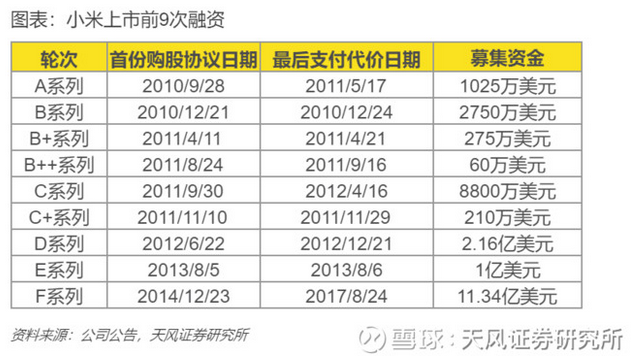
First of all, look at the organizational structure. Xiaomi is a company based on smart phones, extending the industrial chain through smart hardware and consumer goods, and building a strong consumer stickiness network. By directly holding 100% shares of its 10 overseas subsidiaries, Xiaomi Group holds a total of 75 holding sun companies and their subsidiaries. By the end of 18Q1, it has established an ecological chain including more than 210 companies through investment, of which more than 90 are smart hardware and consumer products companies. In the history of Xiaomi, 9 rounds of financing have been completed, raising a total of $1.571 billion.
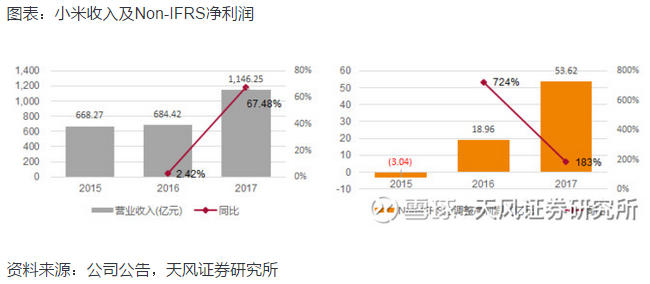
Second, financial data. From 2015 to 2017, the company’s revenue was 66.811 billion yuan, 68.434 billion yuan and 114.625 billion yuan respectively, with CAGR =30.98% and +67.50% in 2017.
YoY; Under non-IFRS measurement (excluding the influence of changes in fair value of cocoa convertible redeemable preferred shares and equity incentives), the adjusted net profit was-304 million yuan, 1.896 billion yuan and 5.362 billion yuan respectively; The net cash flow from operating activities is-2.601 billion yuan, 4.531 billion yuan and-996 billion yuan; The gross profit margin was 4.0%, 10.6% and 13.2%, which was gradually improved.
Revenue in 2016 was basically the same as that of the previous year, but by category, smartphone revenue dropped from 53.715 billion yuan in 2015 to 48.764 billion yuan in 2016, and increased by 65.21% year-on-year to 80.564 billion yuan in 2017, bottoming out. The revenue of IoT and consumer goods segment maintained a steady increase, from 8.691 billion yuan in 15 years to 23.448 billion yuan in 17 years, with a compound growth rate of 64%. The company’s leading market layout IoT has become the world’s largest consumer-grade IoT platform in terms of the number of connected devices (excluding smartphones and laptops), and this layout has also brought strong imagination for Xiaomi’s future development.
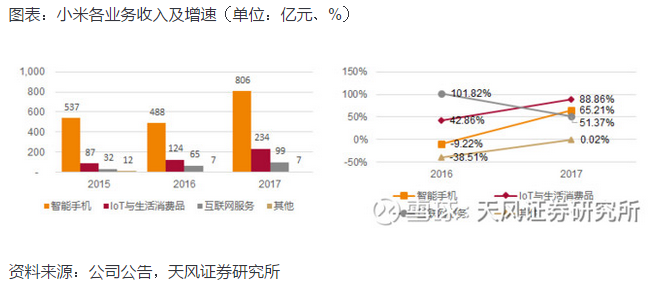
In 2017, the company’s Internet service revenue was 9.896 billion yuan, with a growth rate of 51.37%, which was weaker than that of smartphones 65.21% and IoT and consumer goods 88.86% in the same period. So can we judge that Xiaomi is not an internet company, but a hardware-driven growth company? We don’t think this is the case. The hardware business growth formed by these two parts is the basis for Xiaomi’s Internet expansion. Without a large number of hardware foundations, big data collection is out of the question, and consumer stickiness can’t compete with current giants such as Ali, Tencent, and even headlines and Meituan, so the attributes of the Internet platform are difficult to stabilize. Therefore, whether the final form of Xiaomi Ecology can become an Internet giant, in the short to medium term, we still need to observe the layout of its hardware business, and once it is formed into an ecological network with high valuation, it will be stable. In the following part of the article, we will elaborate on it in detail.
Second, the hardware attributes of Xiaomi:
In the company’s revenue, the hardware part (smart phones, IoT and consumer goods) accounts for a high proportion. In 2017, it contributed 90.74% of revenue and 59.73% of gross profit, which constituted the basic disk of Xiaomi’s ecology. So what is the future growth of hardware business? We think it is divided into two parts:
The future focus of smart phones lies in: stabilizing domestic sales, enhancing brand image+global cost performance;
The focus of IoT and consumer goods lies in: how to form exponential sales, improve penetration rate and form a strong position of smart home & wearable device in the long run under the background of the combination of consumption upgrading and rationalization.
1. Smartphones: increase the unit price with a stable domestic share and seize the market overseas.
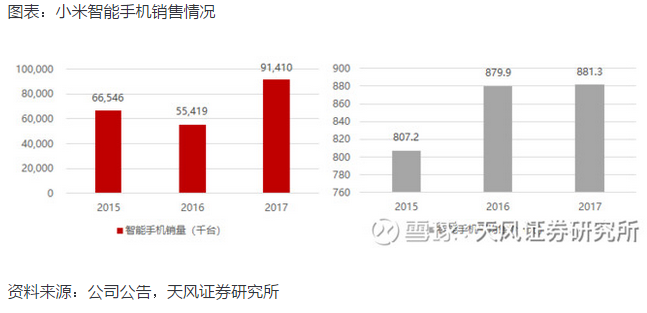
In 2017, the sales volume of Xiaomi smartphones reached 91.41 million units, +64.9%YoY, which rebounded against the trend; The average selling price is 881.3 yuan, which is basically the same as last year. Although the profitability is low, the recovery of mobile phone market share has provided Xiaomi with good cash flow and excellent brand awareness. According to IDC’s global smartphone shipment statistics, under the background of global smartphone shipment slowdown, thanks to the firm foothold in the domestic market and the expansion of overseas markets, the company’s shipment growth rate in the past 17 years is much higher than the industry average growth rate.
1.1 domestic market: gain a firm foothold and reshape the brand image of high-end models.
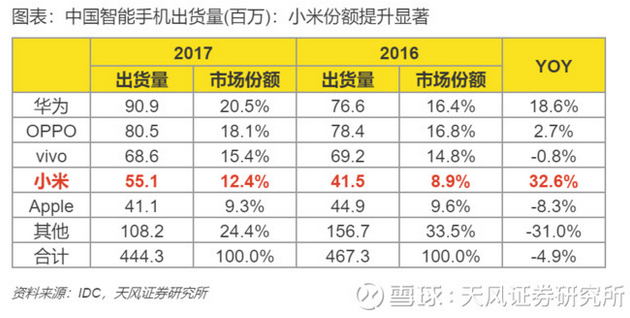
In the domestic market, the market share was further concentrated in the top five manufacturers in 2017, with Cr5 = 75.6% in 2017 > 66.5% in 2016. Xiaomi’s shipment increased from 8.9% in 16 years to 12.4% in 17 years. The reasons for the increase in share are as follows: on the one hand, Xiaomi launched a number of new model combinations covering the low-to-high-end market, and the low-end models were outstanding in cost performance, and the high-end models innovated and radically reshaped the brand; On the other hand, it continued to optimize its marketing and channels, sponsored the high-rated variety show "Hip-hop in China", and Wu Yifan, the spokesperson, further attracted young consumers. In terms of channels, while consolidating online advantages, we will speed up the opening of Xiaomi homes and increase offline distribution. By the end of Q1 2018, there were 331 Xiaomi homes nationwide; In 2017, the average retail income of Xiaomi Home retail self-operated stores was about RMB240,000 per square meter, ranking second among global retail chain stores according to iResearch.
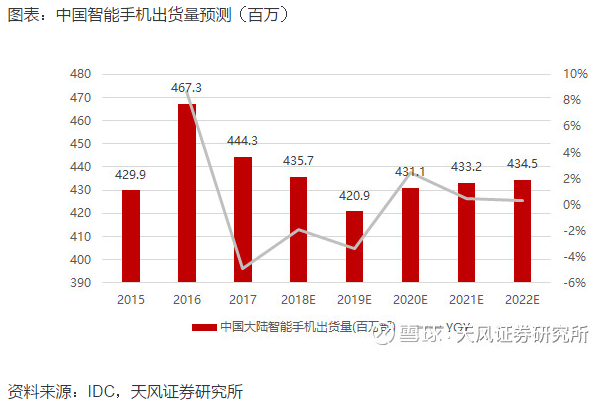
As the domestic market has entered a stable period of stock substitution, the upgrade bonus of low-line consumption has basically ended, and the overall shipment volume may decline to some extent. According to IDC’s forecast, the mobile phone shipment in China market in 2018 may be 435.7 million units, which is lower than the level in 16-17 years. We believe that the focus of Xiaomi’s future domestic smartphone business growth will shift to the change of models. In 2017, the average selling price of Xiaomi mobile phone is still in the low-priced smartphone segment of less than 200 dollars (the proportion of national sales of mobile phones at this price has dropped from 56.8% in 2015 to 39.9% in 2017, down by nearly 17pcts). The upgrading of consumption and intergenerational switching of consumers have made mid-to-high-end models more popular. Recently, Xiaomi Mix2s full-screen mobile phone with a price of 3,299 has been launched by Xiaomi. In the process of consumers’ gradual transformation from the original "diaosi" positioning to "middle class" and "young people", we believe that the layout of average price increase has been further optimized.
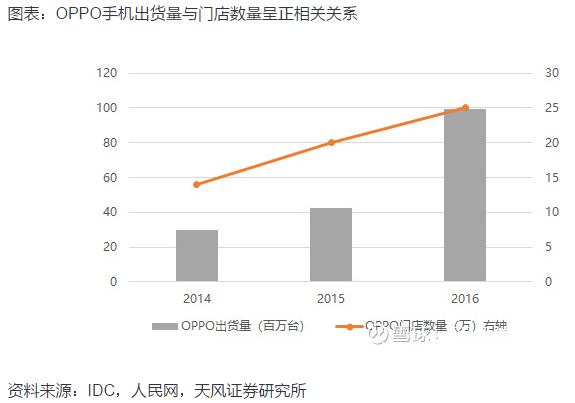
In addition, in the context of laying out offline channels, we believe that Xiaomi still has a greater offline incremental advantage than OPPO and vivo of the same popular models. According to People’s Daily’s statistics on the number of stores, the growth of OPPO’s shipments is basically proportional to the growth of offline stores. The Sino report shows that OPPO and vivo stores in the third-and fourth-tier cities of 18Q1 have once seen the tide of closing stores. Therefore, in this context, we expect that due to the small number of Xiaomi stores and the expansion period, the probability of grabbing offline market share is greater. Therefore, we believe that in the medium and long term, the domestic market shipments of Xiaomi will maintain a steady increase.
1.2 Overseas markets: cost-effective to seize emerging markets.
Overseas revenue data highlights the layout and growth of Xiaomi in overseas markets. In 2015-2017, the company’s overseas revenue was 40.6, 9.15 and 32.08 billion yuan respectively, with a compound annual growth rate of 181%; In 2017, the company’s overseas revenue was 32.1 billion yuan, accounting for 28% from 13% in 16 years, with a year-on-year growth rate of 250.43%.
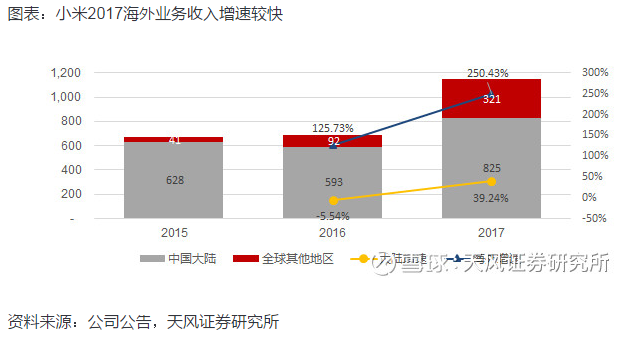
Overseas markets such as India contributed mainly to the growth. By the end of March 18, Xiaomi had entered 74 countries and regions. According to IDC data, 17Q4 Xiaomi ranks in the top five in smartphone shipments in 15 markets around the world, among which India ranks first (26.8%) in terms of market share by shipments, and third (7.3%) in emerging markets (except Australia, Canada, Chinese mainland, Japan, South Korea, the United States and Western Europe). 18Q1 Xiaomi shipped 28 million units worldwide, up 87.8% year-on-year, ranking fourth with a global market share of 5%.
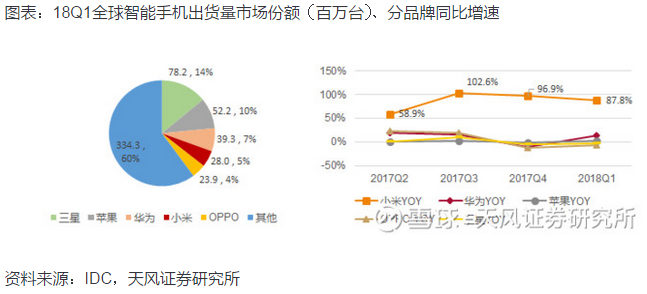
From the perspective of industry trends, according to IDC, the penetration rate of smart phones in overseas emerging markets is still far behind the global average and non-emerging markets. In 2017, the penetration rate of emerging markets was only 37.7%, far lower than the domestic level of 64.5% and 83.1% in other regions. Therefore, smartphone shipments in overseas markets will have greater growth opportunities in the future. For emerging markets, cost-effective smartphones are the best choice. In this respect, we have been partially verified in the Indian market. Although OPPO and vivo have adopted the same strategy of laying offline stores and increasing advertising marketing in India, Xiaomi’s smartphone market share in India has been significantly ahead of the sum of the two (17Q4: 11.4%). The e-commerce strategy adopted in China in that year was effective again, and this time it also optimized the response speed of the supply chain. We expect the growth of shipments in emerging markets to become an important growth engine for Xiaomi’s smartphone business.
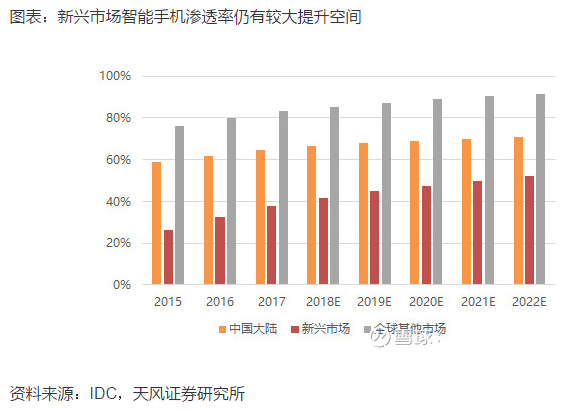
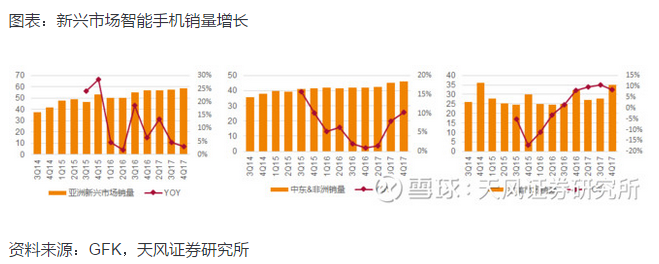
To sum up, we believe that the smartphone business will maintain a steady improvement. The launch of new models with mid-to-high-end price will improve the average sales price and increase the growth of revenue. The overseas market will provide Xiaomi with effective growth in sales.
2. IoT and consumer products: launch explosive products, expand categories and enhance stickiness.
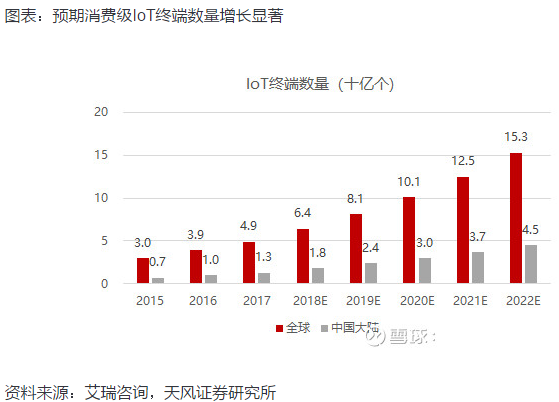
First of all, look at the market size and growth. According to iResearch, the number of global consumer-grade IoT terminals will increase from 4.9 billion in 2017 to 15.3 billion in 2022, CAGR.
=25.4%。 The number of consumer IoT terminals in Chinese mainland market will increase from 1.3 billion in 2017 to 4.5 billion in 2022, with CAGR =28.2%.
According to iResearch, the global sales of consumer-grade IoT hardware increased from $306.3 billion in 15 years to $485.9 billion in 17 years, with CAGR=26%, of which Chinese mainland increased from $71.5 billion to $118.8 billion, with CAGR=28.9%. It is estimated that the global and China consumer-grade IoT hardware sales will reach 1.55 trillion and 311.8 billion dollars respectively in 2022, and the CAGR will be 26.1% and 21.3% respectively in 17-22 years.

2.1 The core of truly forming an IoT network lies in whether it can connect a lot of hardware.
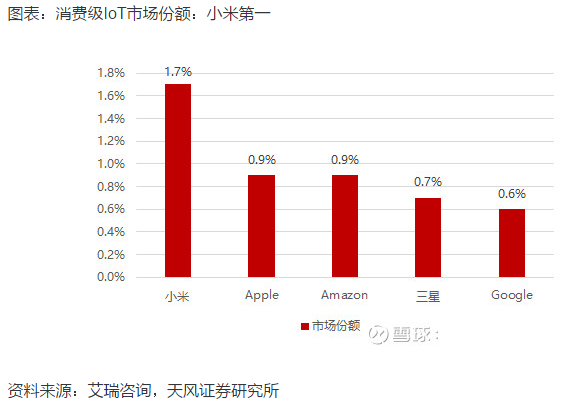
If we say that we are called Internet companies because we earn advertising revenue and game sharing by selling smart phones, I believe we cannot convince most consumers and investors. The reason is that almost all mobile phone companies have their own stores, all of which provide basic apps, which can be divided into advertisements, games and pre-installations. The market still thinks that Apple, Samsung and Huawei are all hardware companies, so why can Xiaomi be given the expectations of Internet companies? We believe that the core is the Internet of Things formed by smart homes and smart hardware built by Xiaomi, which is expected to become the next biggest ecology after the mobile Internet. Unlike PC Internet and mobile Internet, the Internet of Things is highly dependent on hardware, and less mature hardware companies (such as home appliance manufacturers) are willing to actively open third-party ports. Therefore, the basis for the ecological realization of the Internet of Things platform is who owns the most intelligent hardware with different attributes in the connection. The smart hardware market is extremely fragmented. In terms of the market share of consumer-grade IoT calculated by the number of connected devices (excluding smartphones and laptops) in 2017, Xiaomi ranked first with a share of 1.7%, followed by Apple, Amazon, Samsung and Google.
Take smart speakers as an example: smart speakers with speech recognition and AI technology are considered to be an important entrance in the Internet of Things era, so we have seen overseas markets Amazon launch Echo, Apple’s HomePod and Google’s Google.
Home, the domestic market including Alibaba’s Tmall Elf, Tencent’s Listening and Listening, JD.COM’s Ding Dong, Xiaomi’s Little Love classmate, etc. have also been launched one after another to seize the entrance. The value of smart speaker as the entrance of control center is determined, but at present, its function is still relatively insignificant, and it is often regarded as a toy by consumers. Its function mainly lies in setting alarm clocks, listening to music, etc. To really become the entrance of smart home or Internet of Things era, its core key point lies in whether enough hardware can be connected to form data exchange and interaction with each other.
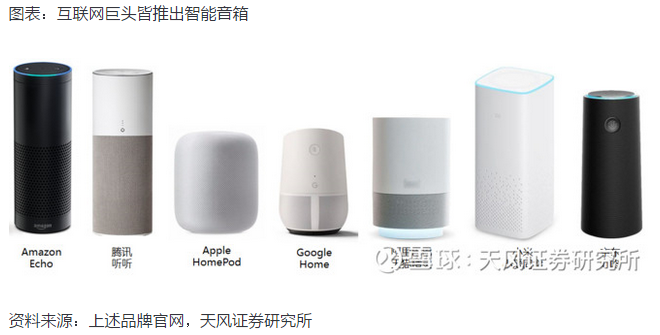
At present, all major Internet companies have launched speakers and developer platforms in the hope of becoming an interface or standard in the field of intelligent hardware in the future. To become a standard, we think it is difficult to rely on pure online mode. Moreover, if the price is high, the penetration rate of various kinds of hardware will not reach a certain level, so smart home will be difficult to achieve, which will lead to the goal of becoming a standard. From the current point of view, we believe that Xiaomi is the company that is most likely to build an Internet of Things ecosystem at present.
2.2 Intelligent hardware network of Xiaomi ecological chain: expanding categories and creating explosions.
Xiaomi has built an ecological chain by investing in more than 90 smart hardware and consumer goods companies. In 2017, the revenue of the company’s IoT and consumer goods division was 23.448 billion yuan, +88.9%YoY, of which the revenue of major IoT products such as smart TVs and laptops was 8.314 billion yuan (accounting for 35.5% of the revenue of this division), +146.5%.
YoY。 According to iResearch data, Xiaomi’s smart hardware, including mobile power supply, air purifier and electric scooter, ranked first in global shipments in 2017, and sports bracelets ranked first in China and second in the world in 2017. In the Double Eleven in 2017, Xiaomi ranked first in terms of shipments in more than 20 product categories of Tmall.
Chart: Construction of Xiaomi Ecological Chain
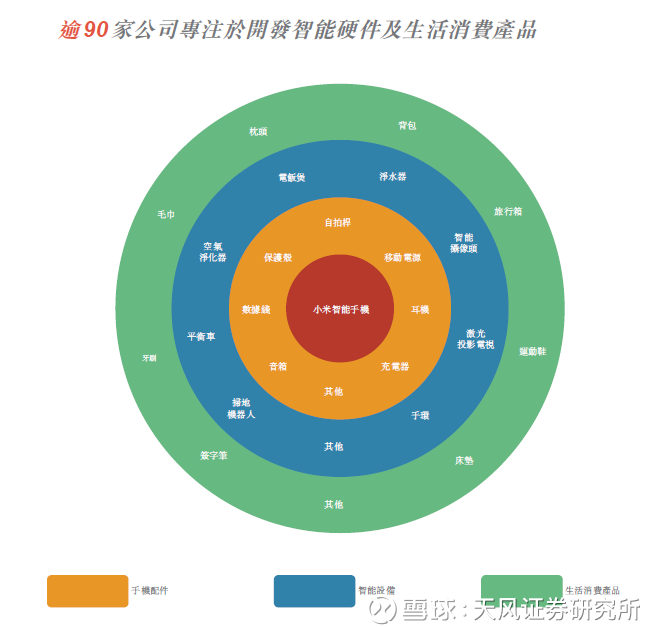
Source: Company Announcement, TF Securities Research Institute.
In the previous section, I mentioned smart speakers that are expected to be the entrance of smart homes. By the end of 18Q1, Xiao Ai could control 118 models of products, including Xiaomi box, Xiaomi sweeping robot, Mijia IH rice cooker, Xiaomi air purifier, Zhimi floor fan and intelligent lamps. From the cumulative number of smart devices activated by Xiao AI, a built-in AI assistant, it has reached 7 million at the end of 2017 and 23 million at the end of 2018Q1. Because Xiaomi is committed to realizing the layout with low gross profit, few intermediate links and high turnover, it is expected to continue to launch explosive products in smart homes, thus creating a gradually improved Internet of Things ecosystem. In addition, by the end of 18Q1, there were more than 580 developers accessing Xiaomi’s IoT developer platform. With the increase of Xiaomi’s penetration rate in the future, it is expected to attract more developers to access, thus forming a good synergy.
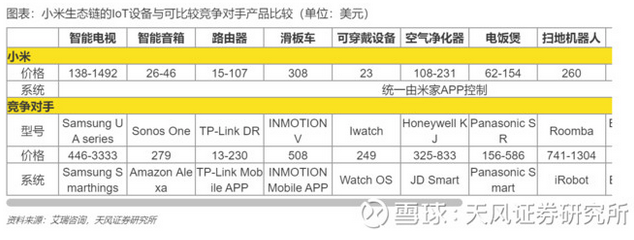
When Xiaomi cut into IoT and consumer goods, he first chose the category in the ant market: that is, the whole market is like a huge cake, which is divided by countless small manufacturers. In the big market where ants share food, there is no absolutely leading big enterprise. The ant market is characterized by a low threshold and is prone to two phenomena of extreme differentiation: 1. There are a large number of cheap and poor products, and 2. The high-quality products are overpriced. For example, air purifiers, patch panels, charging treasures, etc. all had this phenomenon in the past. Therefore, Xiaomi achieved high quality and low price by extremely simplifying the design and compressing the supply chain, thus quickly cutting into 80% of the market and grabbing the share. The negative result is that the market questions whether Xiaomi can have an advantage in the relatively mature hardware market after the category of ant market is developed. We believe that in the field of traditional household appliances such as empty ice washing, the market concentration is high and the head manufacturers are stable, so it is relatively low for Xiaomi to cut in and gain high market share; However, in the small household appliances market that can be intellectualized, due to the relatively low market penetration rate, the company is expected to cut into the cultivation market and continue to expand the category layout.
To sum up, we believe that IoT and consumer goods are the most high-growth businesses of Xiaomi in the medium term. While maintaining the popularity of Xiaomi brand and increasing revenue and cash flow by investing in eco-chain enterprises, it is more important to continue to expand categories and increase the number of connected devices through explosions, which will provide a basis for potential Internet value-added service income in the future.
Third, Xiaomi’s Internet attributes: future expectations
The reason why people from Lei Jun to the prospectus are more willing to define Xiaomi as an Internet company is that the periodicity of hardware is short, just like 18 months in Moore’s Law, and the iterative update speed of hardware products is fast, so it is often difficult to predict the future sustainability after the end of the life cycle of a generation of products. The advantage of network operation is that the strong stickiness of the network can span the periodic fluctuation, so the user value based on the network determines the value of the company, and even the final victory. So we need to discuss whether Xiaomi’s Internet attributes are complete and sustainable.
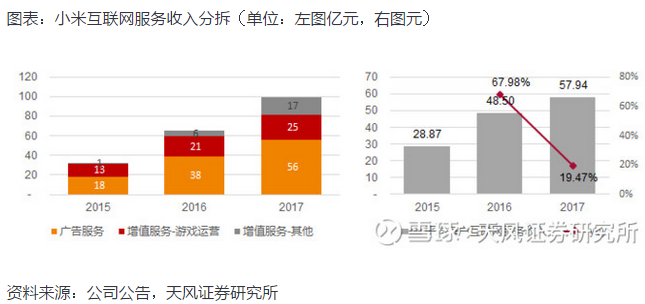
First of all, still look at the income performance and composition. In 2017, Internet service revenue was 9.896 billion yuan, +51.4%.
YoY, accounting for 8.63% of the total income; Among them, advertising service was 5.614 billion yuan, +46.3% YoY, and online game operating income in value-added services was 2.546 billion yuan, +19.3%.
YoY, the income from other services was 1.736 billion yuan, +207.6%.
YoY。 The average Internet service income per user in 2015-2017 was 28.9 yuan, 48.5 yuan and 57.9 yuan respectively. The overall growth rate is not high, so if we only look at this figure, it is difficult for Xiaomi to be truly regarded as an Internet company.
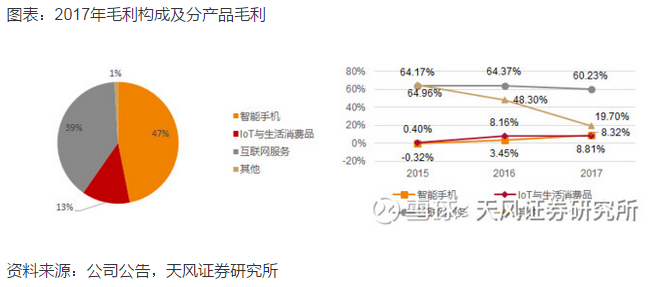
Gross profit contribution: At present, Internet service revenue contributes 39% to the gross profit level, and its gross profit rate is 60.23%, which is significantly higher than 8.81% of smartphones and 8.32% of IoT and consumer goods. It can be expected that after more smart devices are connected, Internet service revenue is expected to accelerate.
By the end of 17th century, the number of MAU in MIUI was 171 million, and it was about 190 million at the end of 18th Q1, which kept a steady increase. It owns 38 applications with more than 10 million MAU and 18 applications with more than 50 million MAU, including Xiaomi Browser, Xiaomi App Store, Xiaomi Music and Xiaomi Video. Although these business data seem bright, we think it does not reflect Xiaomi’s unique Internet attributes.
But this does not mean that Xiaomi does not have Internet attributes. We believe that Xiaomi’s truly unique Internet ecosystem, which is different from most smartphone manufacturers, is still in the incubation period. The reason is that, unlike companies that make hardware profits, Xiaomi sells hardware products in a way close to the cost price (no more than 5% of the net profit level), aiming to build an Internet of Everything platform and provide value-added services on it in the future. Such value-added services include existing advertising services (but they may be intelligently pushed based on multiple smart home hardware and wearable device data) and cloud services, as well as potential big health services, transportation services, education services and so on. And the foundation of all this is intelligent hardware. Therefore, it means that at present, more Internet service income based on smart phones does not show the potential of Xiaomi’s Internet. Xiaomi’s future Internet income lies in the service income of the Internet of Things platform, while the service income and profit of the Internet of Things platform are based on the qualitative change caused by the quantitative change of hardware for a long time.
The risk is that in the domestic mobile phone market facing the pressure of shipment, not only Xiaomi and Samsung, but also other domestic mobile phone manufacturers such as Huawei and OPPO have started the business of intelligent hardware, while competitors include Netease and even Ali and Tencent who have also made smart speakers. In the case of intensified competition, how to ensure the quality to strengthen consumer stickiness and expand the number of connected devices is the key factor for Xiaomi’s Internet service business to finally achieve rapid growth.
Fourth, summary
To sum up, in the short term, we believe that Xiaomi is still a company with hardware as its main source of income, while the realization of the long-term Internet of Things ecological platform is extremely dependent on the scale and penetration rate of its hardware. Therefore, in the long term, Xiaomi’s hardware and the Internet are actually complementary and indispensable, and the income is expected to be equally divided, while the profit is mainly contributed by Internet services. Therefore, in the short term, the market will be more viewed from a hardware perspective, while in the long term, we believe that Xiaomi has the opportunity and strength to become a real next-generation Internet giant.
(Editor: Jiang Yu)

关于作者