
Three astronauts of Shenzhou 12 successfully entered the Tianhe core module.
Chinese entered his own space station for the first time.
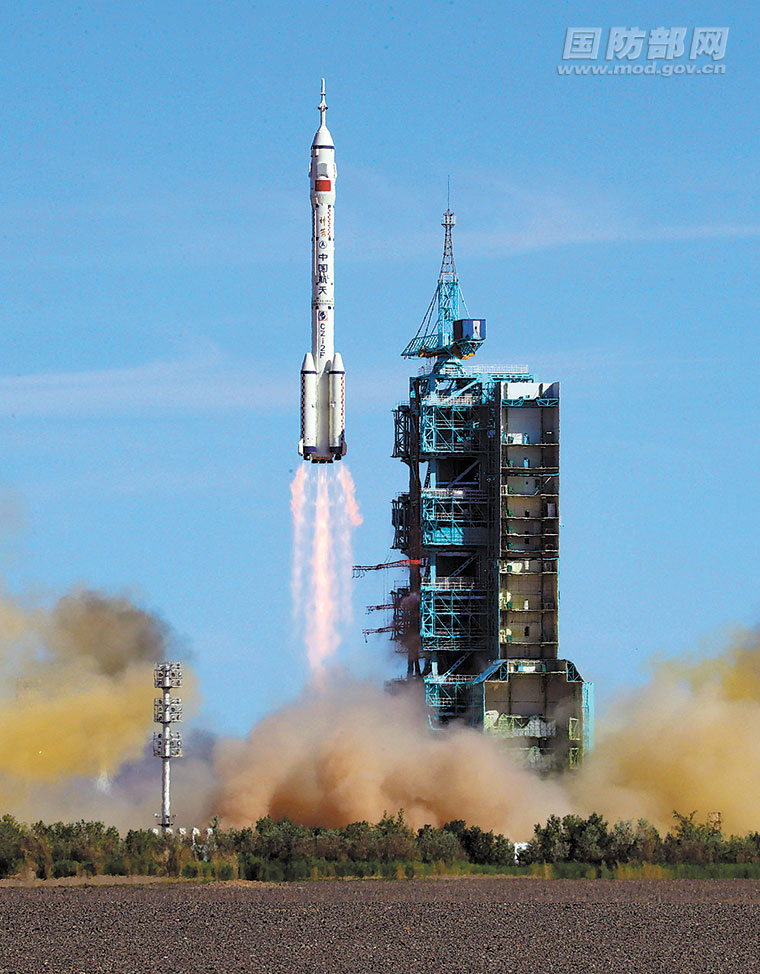
At 9: 22 on June 17, 2021, the Long March II F-12 carrier rocket carrying the Shenzhou 12 manned spacecraft was ignited and launched on time at Jiuquan Satellite Launch Center. About 573 seconds later, the Shenzhou 12 manned spacecraft was successfully separated from the rocket and entered the scheduled orbit, and three astronauts, Nie Haisheng, Liu Boming and Tang Hongbo, were successfully sent into space. The flight crew was in good condition and the launch was a complete success. Wang Weidong and Mu Keshuang, reporters of the People’s Liberation Army Daily, reported on the photos.
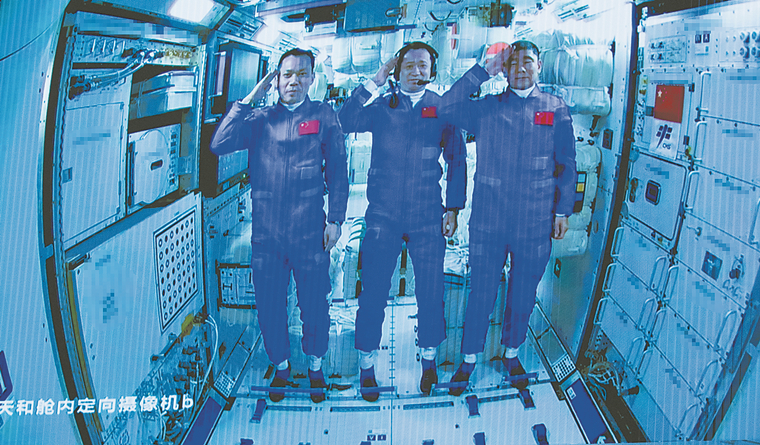
On June 17th, the astronauts stationed in Tianhe and the core cabin in beijing aerospace control center saluted the people of the whole country. Xinhua News Agency reporter Jin Liwang photo
Beijing, June 17th, People’s Liberation Army Daily: Reporters Wang Lingshuo and Cheng Xue reported that on June 17th, astronauts Nie Haisheng, Liu Boming and Tang Hongbo successfully took the Shenzhou-12 manned spacecraft to the sky, becoming the first people to settle in the space station and the core module of China’s manned spaceflight project, opening the first manned mission in the space station phase.
According to the China Manned Space Engineering Office, the Shenzhou-12 manned spacecraft successfully completed the orbit setting. At 15: 54 on June 17, 2021, Beijing time, it successfully docked at the forward port of Tianhe core cabin by autonomous rapid rendezvous and docking mode, and together with the previously docked Tianzhou-2 cargo spacecraft, it formed a three-cabin (ship) assembly. The whole rendezvous and docking process lasted about 6.5 hours.
This is the first rendezvous and docking between Tianhe core module and manned spacecraft since it was launched into orbit on April 29.
After the Shenzhou-12 manned spacecraft and Tianhe core module successfully achieved autonomous rapid rendezvous and docking, the astronauts entered the orbital module from the return module by group. After the preparations were completed according to the procedures, the doors of the node module and the core module were opened successively. At 18: 48 Beijing time on June 17th, 2021, astronauts Nie Haisheng, Liu Boming and Tang Hongbo successively entered the Tianhe core module, marking the first time that Chinese entered his own space station.
Nie Haisheng, who flew three times, and Liu Boming, who knocked on the sky again, together with Tang Hongbo, who first explored space, started the longest space flight in Chinese so far.
In the follow-up, the astronauts will complete a three-month on-orbit stay and carry out related work as planned.
It is understood that the Shenzhou-12 manned space mission is the 19th mission since the implementation of China’s manned space project.
Since the implementation of the "three-step" development strategy of manned spaceflight project by the CPC Central Committee in 1992, after nearly 30 years of independent development and continuous struggle, China’s manned spaceflight has successfully completed all the tasks set in the first and second steps, and is now making full efforts to build a space station and a national space laboratory.
Dreaming for nine days and then asking for heaven, striding for a new journey of strengthening the country.
China’s manned spaceflight project will usher in an unprecedented high-density launch. According to the mission plan for the construction of the space station, 11 missions will be carried out this year and next. In 2022, the on-orbit construction of the space station will be completed and the National Space Laboratory will be built. After that, the space station will enter the operational stage.
China Space Station welcomes the first space visitors.
■ Liberation Army Daily reporter Cheng Xue Wang Lingshuo correspondent Song Xingguang
It’s closer! It’s closer!
At this moment, Xie Jianfeng, the chief mission officer of beijing aerospace control center Shenzhou 12, is staring at the screen of the flight control hall.
At 9: 52 on June 17th, Beijing time, in the distant space, the engine safety inspection backup of Shenzhou 12 manned spacecraft was being tested. This means that astronauts Nie Haisheng, Liu Boming and Tang Hongbo can unlock the lock after receiving the instruction.
At 10: 07, the spacecraft began its first autonomous orbit change. "Through autonomous orbit change, we will gradually lift the orbit of the spacecraft and complete the orbit correction to ensure that the running plane of the spacecraft is consistent with the sky and the core cabin." Li Gefei, an expert in orbit control, said.
The voyage to the "space home" shows the confidence of "China speed"-five years ago, Shenzhou 11 had to fly for two days before it could automatically rendezvous and dock with Tiangong 2; Five years later, the astronauts arrived at the space station in only 6.5 hours. "In five years, our technology has become more and more mature." Sun Jun, chief mission officer of beijing aerospace control center Space Station, said.
The flight to the "space home" touches people’s hearts every second. Compared with the previous launch, this time is greatly shortened. For the flight control center staff, they must concentrate on every second, and they must be foolproof and do emergency treatment at any time.
It’s closer! It’s closer!
At about 14 o’clock, after many independent orbital controls, the astronauts were less than 50 kilometers away from the China Space Station.
Close-range autonomous rendezvous and docking officially started! This time, for the first time, Shenzhou-12 flew to the parking spot 200 meters behind the Tianhe-Tianzhou complex by means of autonomous rapid remote guidance and direct rendezvous and docking of the aiming points.
At the moment, on the big screen, the distance between Shenzhou XII and Tianhe Tianzhou is getting closer and closer. The spacecraft sailed to this "space home" that has been roaming in space for 18 days-
"Docking mechanism capture", "Docking ring pull-back start" and "Docking locking start" …
"The rendezvous and docking is successful!" In the long-awaited event, the Shenzhou-12 manned spacecraft and Tianhe core module completed autonomous rapid rendezvous and docking. At this moment, it is fixed at 15: 54.
At this moment, Tianhe core cabin has adjusted the temperature, humidity and air pressure in the cabin to a comfortable state, only waiting for the first batch of space visitors to enter.
At 18: 48, three astronauts, Nie Haisheng, Liu Boming and Tang Hongbo, changed their heavy cabin pressure suits and put on light blue cabin work clothes, and entered the core cabin one after another, all in one go.
历史将铭记这一刻——中国航天员首次进驻了属于自己的空间站!
飞控大厅里爆发出热烈的掌声。“航天员进驻以后,我们将持续保证他们在太空中安全工作和生活。”北京航天飞行控制中心副总师汪赛进说,“空间站建设是一个长期的巨系统工程,从天和核心舱发射后,管理团队一直在24小时不间断守护。”
航天员进驻天和核心舱后,将执行天地同步作息制度开展工作生活。据悉,核心舱提供了3倍于天宫二号空间实验室的航天员活动空间,保证航天员日常生活起居,同时配置了120多种营养均衡、品种丰富的航天食品。此外,舱内锻炼区内配备了太空跑台、太空自行车,用于航天员日常锻炼。
飞控大厅内,北京航天飞行控制中心空间站任务副指挥杨彦波格外激动。10年前,他见证了神舟八号与天宫一号实现首次交会对接;10年后,还是在同样的地方,他再次见证了神舟十二号与天和核心舱快速对接。“这是我参加载人航天任务10年的最好纪念。”杨彦波说。
从2003年首次进入太空,到2021年进驻中国自己的空间站,中国航天人的追梦脚步越迈越稳健。中国航天的追梦故事,正在书写越来越精彩的篇章。
(解放军报北京6月17日电)

关于作者