
From immediate effect to long-term, from external modification to internal health, from following the trend to rational decision-making, after experiencing the development stage of rapid growth and concept flooding, the beauty and skin care market in China is entering a more mature and calm new cycle. Today’s consumers in China no longer blindly follow the trend and are not easily moved by marketing words, but slow down, examine the real needs and return to the essence of products.
Recently, JD.COM Consumer and Industry Development Research Institute and JD.COM Beauty launched a topic research, and through the dialogue with 1,000 consumers, we learned about the current pursuit and use concept of beauty and skin care products. The Research Report on Beauty Consumption Trends shows that consumers’ understanding of beauty is being reconstructed, and their pursuit of beauty and skin care products points to three core keywords: long-term, natural and streamlined. Behind the change is not only the diversification of aesthetic concepts, but also the overall awakening of health awareness. Everyone’s pursuit of "from the inside out" health status has extended to the field of beauty and skin care.
Specifically, in terms of consumer demands for beauty and skin care products, consumers’ core demands for beauty and skin care focus on health, nature and anti-aging, while paying attention to the emotional value and social attributes of products. The survey shows that 44.4% of the respondents choose "long-term skin care" and 39.0% choose "healthy beauty from the inside out", both of which emphasize the long-term management of skin health, which shows that long-term healthy skin care has become the mainstream demand. In terms of beauty cosmetics, more consumers prefer natural makeup effect, with 33.0% of the respondents choosing "no makeup is better than makeup" and 24.9% choosing "mother gives birth to good skin". They refuse the over-decorated "false face" and pursue "natural good state". On the whole, the demand for anti-aging also shows an obvious trend of "pre-positioning", and 34.8% of the respondents pursue "anti-aging before showing old age". 22.7% of the respondents pursue "self-pleasure" and 21.9% pay attention to "social soft power", which reflects the psychological and social attributes of beauty and skin care consumption.
In terms of consumption concept, the overall consumption of skin care and beauty cosmetics presents three characteristics: "long-term, naturalism and minimalism". The survey shows that 43.3% of the respondents pursue "the effect of daily maintenance is greater than beauty", and 39.2% choose "long-term". Consumers are more willing to pursue simple ingredients and long-term effects, and pay attention to the matching of products with their own needs. They are not obsessed with improving the "immediate state" but pursuing the promotion of "long-term state". At the same time, 30.1% of the respondents are more willing to present "natural makeup", 27.0% of the respondents recognize "precision and simplicity", and generally prefer to pay less attention to makeup effect and skin care methods and pursue "simple beauty".
Is beauty more important or skin care more important? What do they mean to consumers? For the vast majority of consumers, both of them are "indispensable", but they also have their own emphasis. However, whether it is beauty or skin care, consumers want to improve their own state. Beauty and skin care is no longer just a step for "remediation", but a set of long-term systematic projects of "prevention+repair+maintenance".

In addition, the survey results have more findings about the consumption trend of beauty and skin care:
· Basic nursing is the mainstream, and the demand for advanced efficacy is rising. Research shows that facial cleansing, lotion/cream and sunscreen products are the "golden triangle" of basic skin care. The increase in the frequency of use of facial essence and lotion indicates that consumption is advanced to functional products. In the pursuit of efficacy, moisturizing and hydrating are still the core, and advanced needs such as anti-aging/anti-wrinkle, whitening and oil control are obvious. In addition to basic care, consumers’ product selection and skin care concepts have become more focused, focusing on long-term use effects.
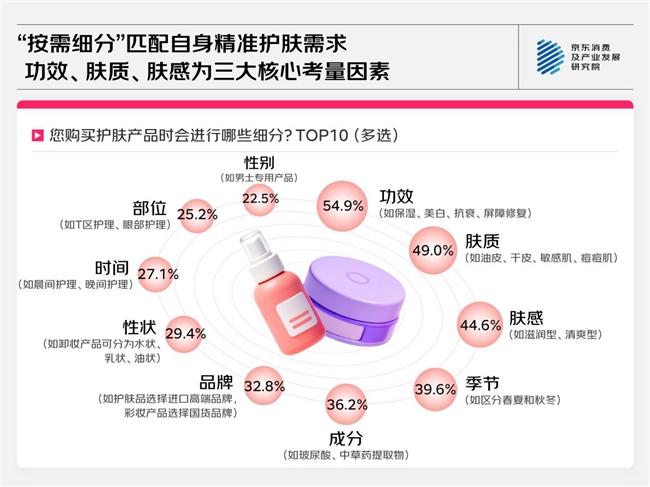
· Consumers will pay attention to the matching degree between different product ingredients and their actual needs, and pursue the long-term health of the skin. According to the survey, only 4% of the respondents never pay attention to ingredients. At the same time, consumers pay attention to multi-angle segmentation of their own needs and "matching on demand" has become an important trend. The survey shows that 54.9% of the respondents will subdivide "efficacy (such as moisturizing, whitening, anti-aging and barrier repair)", nearly half of the respondents will subdivide "skin type (such as oily skin, dry skin, sensitive muscles and acne muscles)" and 44.6% of the respondents will subdivide "skin feeling (such as moisturizing and refreshing)".
· "Medical beauty" and "cinema-level" skin care products gradually gained a certain market recognition. In the choice of functional products consumption, 74.4% of the respondents used functional products such as acids and alcohol. At the same time, consumers pay great attention to "safety and reliability", "use effect" and "cost performance" when choosing "medical beauty" products. From the perspective of "long-term doctrine", consumers pay more attention to whether "medical beauty" skin care products can help them get long-term quality experience rather than immediate obvious effect, and safety surpasses others and becomes the most important decision-making factor.
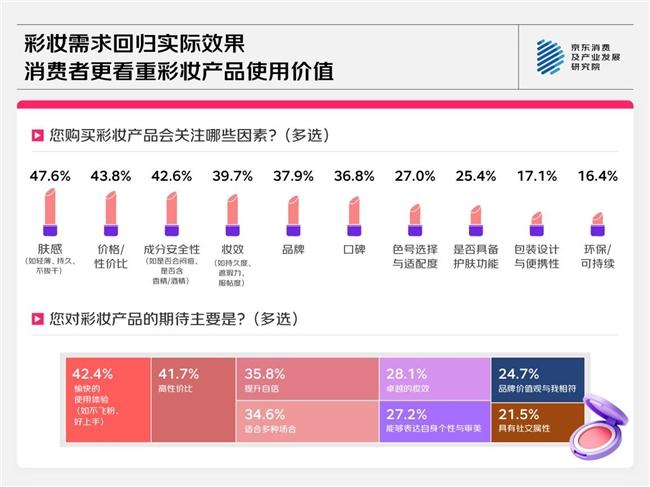
· The pursuit of makeup has become the core demand of this consumer’s beauty products consumption, and daily and efficient products have become the core category of beauty products consumption. The survey shows that commuter makeup and pseudo-plain makeup are the most frequently pursued makeup styles, and they prefer clear and natural makeup and even skin color. In the process of purchasing, 47.6% of the respondents emphasized the "skin feeling" experience, preferred low-cost beauty products and looked forward to a more natural feeling.
· In addition to pursuing the efficacy of products, consumers are also very concerned about the purchase channels when purchasing, and choose a more trusted platform to ensure the product’s "integrity and fidelity". The survey shows that "authentic" is one of the important factors that affect the decision-making of most consumers. 92.4% of the respondents attach importance to authentic products, and 60.6% of them regard it as a "decisive factor". The emphasis on "genuine products" is also reflected in the choice of consumption channels. 81.0% of users buy beauty and skin care products through JD.COM, and 67.6% of the respondents choose this channel because of "genuine protection".
· Domestic beauty and skin care brands have risen. According to the survey, among the skin care brands, the domestic head brand has the highest vote rate, accounting for 42.5%; In the choice of make-up, domestic head brands and imported high-end brands have the same votes, accounting for 33.2% and 35.2% respectively. In the survey, consumers believe that the advantages of domestic beauty and skin care products are "more suitable for Chinese skin" (56.8% of the votes) and "high cost performance" (52.8% of the votes).
· Consumer behavior is becoming highly scene-oriented. Gifts, as an important consumption scene, drive the consumption growth of beauty and skin care product gift boxes. In addition, early adopters and travel drive the consumption growth of sample beauty products. According to the survey, 72.1% of the respondents have bought beauty and skin care gift boxes, the main purpose of which is to give gifts; At the same time, many consumers will choose to buy small packaging products, and 82.2% of the respondents have bought samples/trial packages. In the usage scenario, 45.6% of the respondents travel and 42.3% of the respondents use them for tasting new products.
Long-term pursuit, advanced skin care and on-demand segmentation
Skin care needs from basic care to anti-aging needs.
Cinema-level skin care products are gradually moving from "niche" to "mass"
The development of the times drives the change of ideas. When skin care becomes an important part of life, consumers trust data, respect science, and pursue a scientific skin care system with traceable ingredients, visible efficacy and sensible experience. At the same time, skin care has also been given more emotional value-from "daily task" to "self-ritual".
Generally speaking, basic care is still the ballast stone in the skin care market, but consumers are no longer satisfied with single moisturizing and hydrating, and advanced needs such as anti-aging, whitening, anti-aging and repair are rising, which also promotes the development of skin care products in the direction of refined functions to better meet the diversified needs of consumers. According to the survey, among the skin care products most commonly used by consumers, "facial cleansing", "lotion/cream" and "sunscreen" rank in the top three, which constitute the "golden triangle" of basic skin care, accounting for 54.2%, 50.8% and 48.1% respectively. 43.6% of "facial essence" and 41.2% of "make-up water" followed closely, showing that they gradually advanced to functional products on the basis of basic nursing.
The same advancement is also reflected in the use target of skin care products, which is above the mainstream demand of "moisturizing" (51.1%) and "hydrating" (50.0%). 36.8% of the respondents chose "anti-aging/anti-wrinkle", 35.0% chose "whitening", 32.4% chose "oil control" and 31. This is also in line with the skin care feeling that consumers expect. According to the survey, 36.6% of the respondents expect the feeling of "youthful skin" in addition to the basic "refreshing and non-greasy", "water-oil balance" and "safety without burden".
In addition to the functional needs of skin care, consumers also pay attention to the sensory experience and emotional resonance brought by skin care, and the skin care experience of "healing system" is very important for this session of consumers. According to the survey, 65.8% of the respondents expect skin care products to bring "comfortable texture and touch", while 49.9% choose "pleasant smell", which is much higher than the "packaging design" chosen by 23.8% and the "sense of using ceremony" chosen by 33.2%. Most consumers expect the emotional value provided by skin care products from "self-feeling".
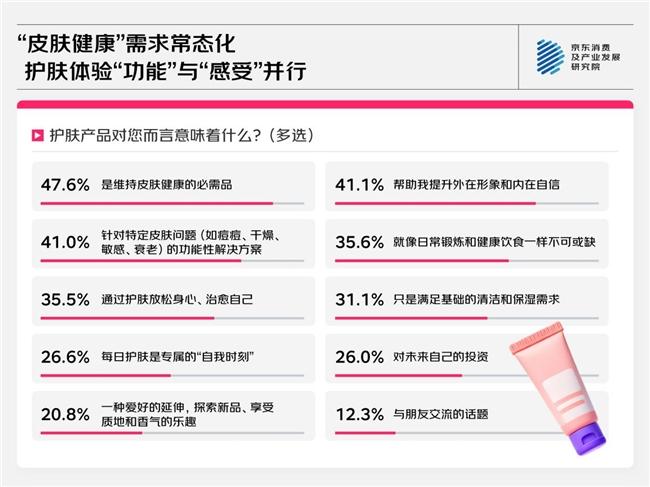
At the same time, 47.6% of the respondents regard skin care products as "necessities to maintain skin health", and 41.0% of the respondents expect skin care products to be "functional solutions for specific skin problems"; 41.1% of the respondents believe that skin care products can help them "improve their external image and internal self-confidence", and 35.5% of the respondents believe that they can "relax and heal themselves through skin care". It is not difficult to find that the "practicality" and "feeling" of skin care products are equally important to consumers.
Facing all kinds of skin care products, consumers’ attitude is becoming more and more professional, and "transparent ingredients" and "scientific proportion" have become the cornerstones of trust, and they think that clinical data or expert endorsement is more reliable. It has become a normal state for consumers to rationally choose skin care products by paying attention to ingredients and understanding the ratio. According to the survey, 62.1% of the respondents always pay attention to ingredients, and only 4% of the respondents never pay attention to ingredients. Among the users who pay attention to ingredients, 46.5% of the respondents want to "avoid harmful ingredients", 40.3% want to "avoid allergens" and 33.6% want to "confirm effective ingredients".
Consumers are more clear about their actual needs through multi-angle segmentation, so as to make rational decisions and choose skin care products that better match their actual needs, and the choice is more clear and systematic. The survey shows that 54.9% of the respondents will subdivide "efficacy (such as moisturizing, whitening, anti-aging and barrier repair)", nearly half of the respondents will subdivide "skin type (such as oily skin, dry skin, sensitive muscles and acne muscles)" and 44.6% of the respondents will subdivide "skin feeling (such as moisturizing and refreshing)".
Focusing on functional products, 74.4% of the respondents used functional products such as acids and alcohol A, which had a wide audience. "Medical beauty" skin care is in the stage of market education. Consumers are willing to pay a premium to get "real and effective" and "safe and reliable" in the consumption decision of "medical beauty" and "cinema level" skin care products. The data shows that when choosing medical beauty products, 49.2% of the respondents are most concerned about whether they are safe and reliable, 34.7% are concerned about the effect and speed of use, and 30.8% are concerned about the price and cost performance, which is the most important decision-making factor for consumers to choose medical beauty products and cinema-level skin care products.
Simplification of ingredients, light burden on skin, and high adaptation have become the new criteria.
Make-up demand returns to "true beauty"
Make-up consumption pays attention to natural makeup effect, pragmatism and self-satisfaction.
Reject the "mask feeling" and embrace the "original feeling". The makeup effect should be natural, the function should be practical, and the experience should be pleasant-for this consumer, the natural makeup effect is really popular. The consumption of beauty products is shifting from "concealer" to the carrier of "self-confidence expression" and "self-pleasure", showing a trend of coexistence of complexity, practicality and emotional value.
From the perspective of makeup style, 55.8% of the respondents prefer "commuting daily makeup" and 38.2% prefer "pseudo-plain makeup". From the two dominant makeup styles, consumers prefer natural and efficient makeup. In daily commuting scenes, makeup and lipstick are most frequently used. Specifically, lipstick accounts for 40.3%, liquid foundation/cream accounts for 36.7%, makeup remover accounts for 36.4%, followed by air cushion for 31.0% and concealer for 29.1%.
In terms of specific makeup effect, most consumers are more pursuing "clear and natural" makeup effect. The survey shows that 39.3% of the respondents prefer "clearness and naturalness" and 32.5% attach importance to "even skin color". Consumers hope that make-up "looks like no make-up" and highlights the true beauty, rather than just covering up the true state of skin through make-up products, which also drives consumers to choose more light and natural beauty products.
In the process of use, consumers value the actual value of make-up products and expect a pleasant experience in the process of use. According to the survey, 42.4% of the respondents expect to bring "pleasant experience (such as no powder, easy to use)" through make-up products, and 47.6% of the respondents pay attention to "skin feeling (such as lightness, durability and no dryness)" when buying make-up products, which shows that "practicality" has become an important decision-making factor for consumers when facing make-up products.
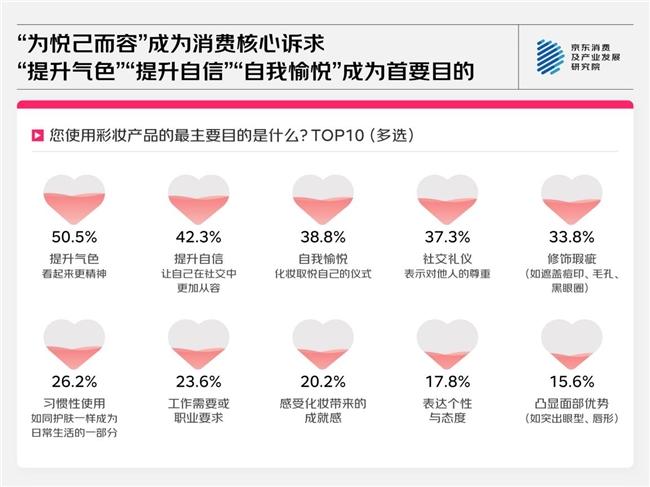
Make-up products are not "face-changing tools", but "self-confidence blessing devices", which are an important carrier of consumers’ self-expression and emotional management, and an important tool to highlight self-confidence and increase "social capital". According to the survey, consumers are more looking forward to "pleasing themselves" by using make-up products, more than half of the respondents are looking forward to "improving their color and looking more energetic", 42.3% of the respondents are looking forward to "enhancing their self-confidence and making themselves more comfortable in social interaction" and 38.8% of the respondents are looking forward to "self-pleasure and the ceremony of making up to please themselves". 23.5% of the respondents often adjust their makeup, and 45.7% of the respondents occasionally adjust their makeup. This year’s consumers are willing to adjust according to the actual needs, and makeup has become an important part of improving their own state and gaining a sense of healing.
"practicality" and "sensibility" in the consumption of beauty cosmetics and skin care products
Imported high-end brands firmly occupy the technical highland, and domestic brands break through with "high cost performance"
Scenario demand-driven gift box and sample consumption growth
In the process of consumption of beauty and skin care products, consumers not only pay attention to the practical and tangible parts such as ingredients, efficacy, price, channels and packaging, but also care about the high-dimensional feelings of brand stories, use experience and emotional identity. Consumers are becoming more rational, professional, emotional and scene-sensitive. They not only pursue the balance between efficacy and experience, but also pay attention to the safety of ingredients and the guarantee of authenticity, and are also willing to pay for emotional value and self-expression. Driven by the change of consumer demand, domestic brands have risen rapidly with the advantages of cost performance and localization, but in high-end markets and international brands, they still have advantages in ingredient technology and brand accumulation, and consumer behavior is also highly scene-oriented.
In the purchase decision, consumers become more rational, thinking that "efficacy is the starting point of purchase, and genuine products are the bottom line of transaction", and consumers are still "pragmatists". The survey shows that "efficacy", "skin feeling" and "authentic" are the three core factors, and the proportion of respondents is 52.4%, 47.5% and 43.1% respectively. "Authentic" is extremely important to consumers’ decision-making. Over 90% of consumers will pay attention to whether beauty and skin care products are genuine or not. Among them, 60.6% of the respondents think that "authentic" is a "decisive factor" in the decision-making of beauty and skin care products, and 31.8% of the respondents think that this is an "important factor". In order to meet the demand of "buying genuine products", 81.0% of the respondents are used to buying beauty and skin care products through the platform of JD.COM, and 67.6% of the respondents believe that the main purpose is to choose platforms such as JD.COM to run their own "genuine products protection". It can be seen that for the vast majority of consumers, channel trust and genuine guarantee are unshakable bottom lines.
Values are also an important factor affecting consumption decision-making. Social responsibility, environmental protection concept and cultural self-confidence have all become components of a brand and a product, and brand values will gradually affect consumption choices. According to the survey, 24.5% of the respondents will "give priority to brands with values", and 16.7% of the respondents refuse to buy products that do not meet their own values. It can be seen that values are becoming a filter for consumption decisions of beauty and skin care products.
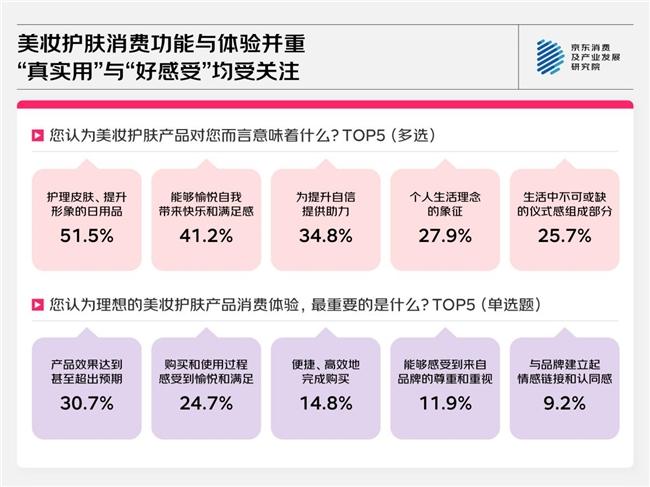
In the process of using beauty and skin care products, consumers want not only the results, but also the process. Experience upgrading and emotional resonance have become an important concern of consumers. In terms of product meaning, 51.5% of the respondents regard beauty and skin care products as "daily necessities to care for the skin and enhance the image", 41.2% of the respondents think that it is a source of happiness that can "please oneself and bring happiness and satisfaction", and 34.8% of the respondents think that it can "help improve self-confidence". In terms of use value, in addition to the actual efficacy, 51.4% of the respondents expect a "more comfortable experience" and 45.1% of the respondents hope that the product can "relieve stress and bring pleasure".
This has also affected consumers’ consumption expectation of beauty and skin care products. According to the survey, 30.7% of the respondents expect that "the product effect will reach or even exceed expectations" and 24.7% of the respondents expect that "the purchase and use process will make them feel happy and satisfied". It is not difficult to find that the product strength is always the absolute core, and the consumption always revolves around whether the product is really effective and whether it brings a pleasant experience.
When consumers buy beauty and skin care products, they will not only pay attention to the efficacy and price of the products themselves, but also pay attention to the brands. In terms of skin care products, 42.5% people tend to choose domestic head brands. Respondents believe that the products of these brands can achieve the effect of "more suitable for Chinese’s skin", and the products mainly focus on basic cleaning, face cream and other daily high-frequency use categories. In the choice of domestic brand products, there are still some people who tend to choose cutting-edge domestic brands, and are willing to try brand products that are newly listed or have never experienced themselves. The reasons for choosing products are "cost performance" and "new ingredients". The proportion of people who tend to choose imported high-end brands such as SK-II and Hailan Mystery is 36.7%, and more than half of the respondents think that high-end imported brands have "guaranteed product quality" and "guaranteed technology accumulation and word-of-mouth in efficacy". These consumers are highly sensitive to the actual effect and safety of products, and will pay more attention to imported high-end brands in products such as facial essence and eye cream/eye essence. Different from skin care products, the votes of imported high-end brands in cosmetics are slightly higher than those of domestic brands, among which the proportion of imported high-end brands in perfume/fragrance and base makeup products is higher, and lipstick/lipstick products made in China are more concerned.
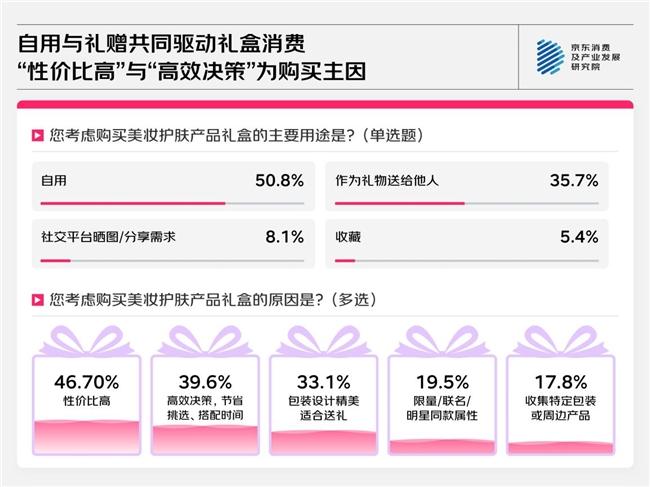
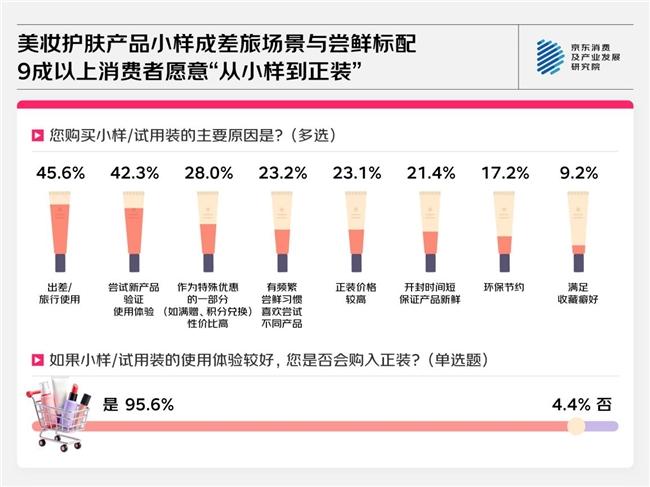
Consumer behavior is becoming highly scene-oriented. Gift scenes drive the consumption growth of beauty and skin care products gift boxes, while early adopters and travel drive the consumption growth of sample beauty products. According to the survey, 72.1% of the respondents have bought gift boxes. For the purpose of purchase, 50.8% of the respondents are for their own use and 35.7% are gifts, which are two important consumption scenarios of beauty and skin care product gift boxes. "High cost performance" and "efficient decision-making" are two important reasons for consumers to buy beauty and skin care product gift boxes, accounting for 46.7% and 39.6% of the respondents respectively. The sample/trial outfit is widely accepted. Over 80% of the respondents have bought the sample/trial outfit, and their main motives are "traveling" and "trying something new", accounting for 45.6% and 42.3% respectively. The consumption of beauty and skin care products is changing with the scene and the demand. And more than 90% of users think that if the sample/trial experience is good, they will buy formal clothes. "Try before you buy" has become a popular choice, and "experience" has been placed as one of the core links of consumption decision-making. In essence, consumers vote of confidence for products through personal trial.
The beauty and skin care market in China is undergoing a profound change from external modification to internal health, from passionate pursuit to rational choice, from functional satisfaction to emotional resonance. Consumers are willing to actively study ingredients, rationally compare efficacy, attach importance to genuine products, and are also eager for products to bring emotional value and realize self-expression.
When consumers talk about beauty and skin care products, they expect the actual efficacy and experience brought by beauty and skin care products, and refuse the extra burden and pressure. Beauty and skin care is a life behavior, but also an independent and sober attitude-not perfect, but healthy and natural; Not an instant change, but a long-term companionship; Instead of following the trend with passion, it is concise and effective, which essentially stems from consumers’ respect and recognition of self-demand, and others’ recognition and second, self-acceptance is the way home.
China’s beauty and skin care market is entering a new stage of paying equal attention to rationality and emotion, which is a more rational, delicate and confident consumption era. It belongs to consumers who clearly know what they want and are willing to pay for truth, health and self-pleasure. Let’s participate together and be better ourselves in the new era of beauty and skin care consumption.

关于作者