
Original Wang Caiyong Fudan Youth
Not just books, not just reading. Reading takes books as a springboard to lead to the main body of the article, deeply analyzes the connotation of each book, and builds a bridge between each author and readers.
Abstract and Empathy, written by German art historian Wilhelm Worringer (1881-1965), is a classic of aesthetics, which successfully opened the door to modern art. Today, there is no doubt that we have regarded abstraction or formalization as the basic elements of modern art. However, in the history of modern art development, how did abstraction successfully replace empathy? Wallinger’s book gives an in-depth exposition and analysis from the psychological point of view. More importantly, it not only discusses the two artistic methods of "abstraction" and "empathy", but also explains many concepts and ideas in art, which leads us to a new understanding of artistic style.
Wang caiyong
Chinese Translator of Abstraction and Empathy
Professor Wang Caiyong, Doctoral Supervisor, Chinese Department, Fudan University
His research direction is literature and art.
Interview and arrangement of Fudan young reporter Yuan Suying, Yin Yixin and Yang Yue
Written by Xiao Shufang, a young reporter from Fudan University
Fudan Young Reporter Yang Junyao Editor
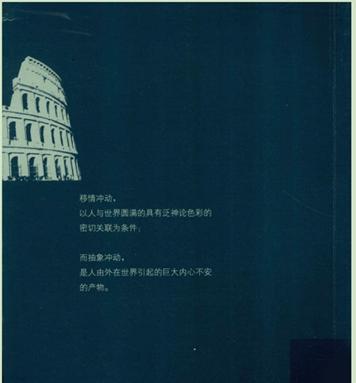
▲ "Abstraction and Empathy" 2010 edition back cover/photo by Xiao Shufang
First, what is "abstraction" and "empathy"?
This book was written at the beginning of the 20th century, a historical period when modern art began to develop in all directions. At that time, the theory of empathy was still dominant in the art theory circle.
The modern theory of empathy can be traced back to the contemporary aesthetics, which took the decisive first step from aesthetic objectivism to aesthetic subjectivism. Empathy advocates that "aesthetic enjoyment is an objective self-enjoyment", which is characterized by "pondering the self itself in a perceptual object different from the self, that is, moving the self into the object". The book gives an example: the depth of color does not depend on the color itself, but on our feelings about the color. Our inner activities, inner life and self-realization are simply "feelings", which are the decisive factors of aesthetic activities. It pays attention to "organic beauty" and takes general apperception activities as a prerequisite. "apperception" is a basic psychological theory in the educational thoughts of Johann Friedrich Herbart (1776-1841), a German philosopher and psychologist, and was first put forward by Gottfried Wilhelm Leibniz (1646-1716). It mainly depends on the influence of the existing content in the mind. Through apperception, people understand, remember and think about the concept of mutual union, so that advanced thinking activities can be completed. German psychologist and aesthetician Lipps (1851-1914) and Karl Groos (1861-1946) are all supporters of this theory.
Wallinger was keenly aware that "Empathy Theory" is no problem to explain the mainstream art styles since ancient Greece and Renaissance, but it is obviously no longer applicable to the emerging modern art. Although modern art has not been fully formed in the early 20th century, it has already appeared a remarkable feature-abstraction or formalization. In line with the changes of art itself, artistic theories and principles should also be adjusted or even subverted, which is the theme of this book-abstract aesthetics.
Abstraction is to reproduce the essence of an object in the human mind by using concepts through analysis and synthesis. Abstract aesthetics starts from people’s abstract impulse, and it pays attention to inanimate "inorganic beauty", in which people are satisfied.
Taking architecture as an example, the basic function of the pyramid is the tomb, which "is subject to utilitarian purposes as a three-dimensional creation"; On the other hand, it exists as a symbol that stands on a broad plane, has a wide range of functions and is full of pleasant content, and the original utilitarian purpose takes a back seat. It puts great emphasis on "the clear expression of material personality, strict geometric regularity and the transformation of three-dimensional characteristics into plane impression", which is abstraction.
Abstraction and empathy are not completely opposite. Although Wallinger emphasized the central role of abstract principle in modern art, he admitted that the combination of empathy and abstraction "can become an all-encompassing aesthetic system".
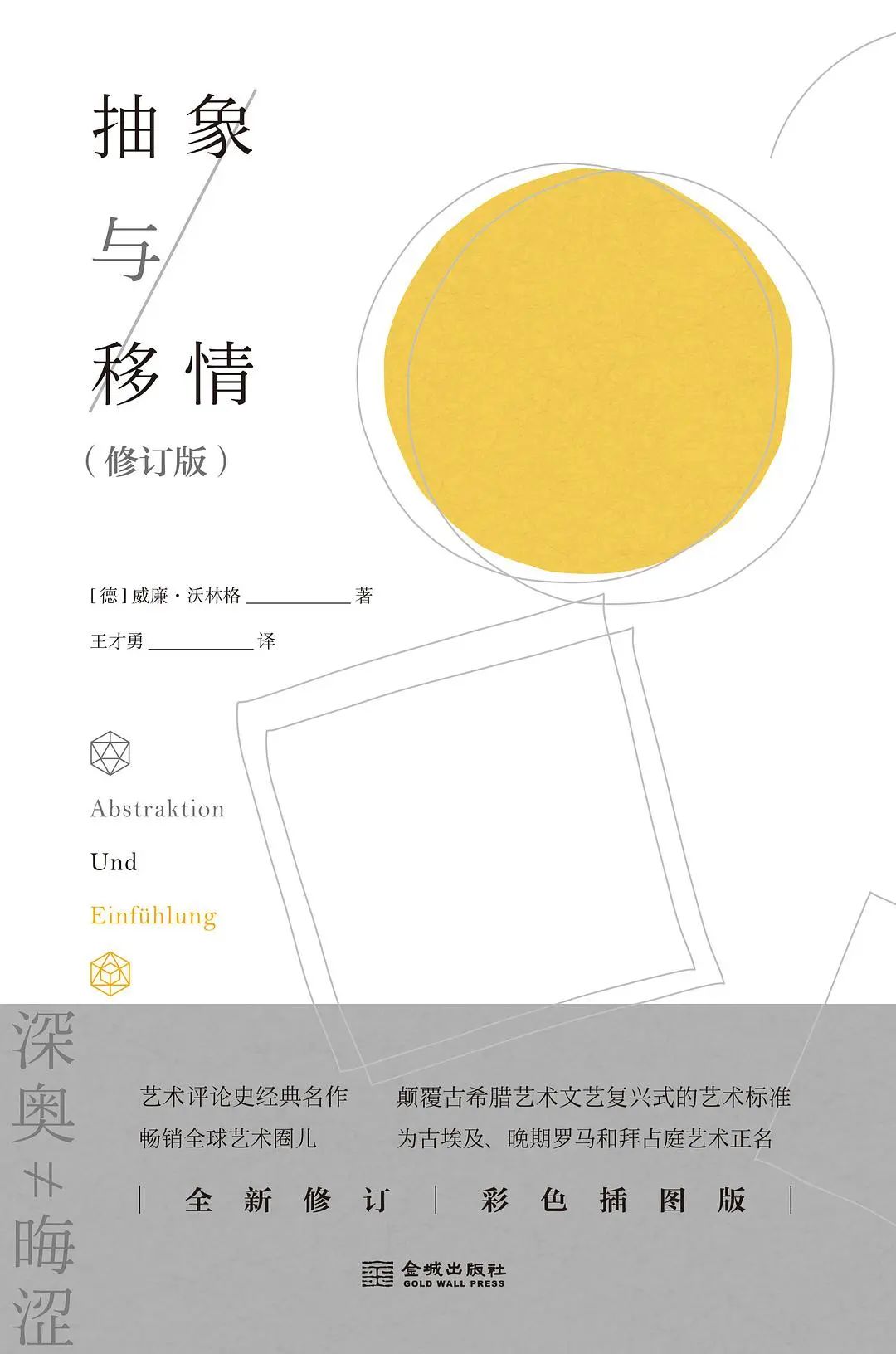
▲ "Abstraction and Empathy" Jincheng Publishing House 2019 cover/Source: Network
Second, reverse thinking: moving towards the core of modern art along the ancient art.
Teacher Wang pointed out at the beginning that although the title of the book juxtaposes "abstraction" with "empathy", it just wants to tell readers that there are these two links in art. In fact, the book only regards "empathy" as a concept corresponding to "abstraction" and serves abstraction. Of course, this does not mean that the Greek tradition of empathy will be completely marginalized. According to the development of art since ancient Greece, "Empathy Theory" is widely understood and accepted, while "Abstraction Theory" has little influence. In order to balance, Wallinger emphasizes abstraction in his writing.
The purpose of Wallinger’s writing this book is to demonstrate "how contemporary aesthetics based on empathy abstract concept is inconsistent with the vast art history", especially with modern art, and finally reveal the key significance of abstract aesthetics. Ingeniously, Wallinger did not directly refute the "Empathy Theory" from the perspective of modern art, but discussed the ancient art from ancient Egypt through the late Rome to the Byzantine period. The premise of this idea is that ancient Egyptian, late Roman and Byzantine art is similar to modern art in one important respect-different from mainstream ancient Greek art, Wallinger believes that the reason why "non-mainstream" ancient art is ignored by people is precisely because they are based on abstract needs and deviate from the empathy track. If we can fully explain and analyze the abstract artistic psychology in ancient art represented by ancient Egypt, late Rome and Byzantine art, and show the great expressive force of abstract art, then we can effectively point to similar modern art, thus demonstrating the value and aesthetic basis of modern art.
In addition, at that time, modern art did not fully show its own form and style, which belonged to "new art". At this time, it is difficult to tell the problem clearly by simply starting from a young art itself, especially to provide strong evidence for explaining the position of abstract psychology in the future development of modern art.
On the contrary, because of this, the book Abstraction and Empathy is not only of great significance for establishing the abstract principle in modern art, but also "shows the rationality of modern art at that time"; It also explains "the existing value of ancient art that has not been fully valued by future generations", which inspires us to pay more comprehensive and objective attention to the history of art development.
Third, the proposal of "abstract theory"
Empathy theory holds that empathy activity is a prerequisite for artistic creation under any circumstances. However, as long as we look at "the huge artistic synthesis that breaks through the narrow artistic framework", we will find that this speculation is untenable and we must introduce some other concepts to explain art.
Wallinger thought about how to make the term "abstraction" and its confrontation with empathy widely understood and accepted. As a result, he borrowed well-known concepts such as "style" and "naturalism", which is a shortcut.
In the 1960s, Gottfried Semper ,1803-1879), a German art theorist and architect, published the book "Style in Technology and Structural Art", which concentrated on the characteristics that the theory about the origin of artistic works in the 19th century was mainly based on the materialistic viewpoint. This feature leads to the neglect of the intrinsic nature of works of art and the focus on the subsidiary elements of works.
Wang Caiyong pointed out that "style" was originally based on the history of literature and art, as a symbol to divide the groups of works and artists, but Wallinger thought that "style" was refined by artists, not a natural form. Whether it is literary or visual art works, it is the result that artists integrate their subjective feelings into the form. "Style" in this sense is not the same as naturalism. It has its own "feeling" in it, that is, the subjective processing of the creator is extracted from the given form of nature, which corresponds to "abstraction".
Later, an Austrian art historian named riegel (1858-1905) lashed out at Semper’s theory and put forward the second concept we want to talk about-"artistic will".
"’artistic will’ is will in English, and different people will have different wills. Riegel was the founder of the Viennese School, which was a very influential school in the study of European art history at that time. Wallinger cited his concept. To better understand "artistic will", we can start with "formal will". The formal characteristics of visual art works, even the works of artists from the same genre or even the works of the same artist in different periods, are different in color and movement.’ Formal will’ is to analyze why this is the case. Simply put, it is why artists want to do this, and of course it is not arbitrary. Whether an artist, a group, a nation or a country has a specific will and a specific form will. Will is caused by various factors, for example, for an individual, that is, his experience, emotions, thoughts and psychology, and so on. Wallinger did not discuss this in depth in the book. If you want to continue to dig, you can see riegel’s systematic exposition. "
Hegel also had the view that "absolute spirit is also an objective". Is it related to artistic will? Teacher Wang Caiyong’s answer is:
"Vienna school’s era is a little later than Hegel’s, but such association is possible. Because Hegel repeatedly emphasized the idea-idea, which is objective and universal, and does not depend on human will, the point that "artistic will" used by the Vienna School is "not determined by people at will" is actually consistent with Hegel’s objective spirit. In addition, the important point of Hegel’s objective spirit is that it precedes the social trend and is ontological. However, artists do not go deep into the ontological level to elaborate. They just want to use "artistic will" to show the pursuit, surge or instinct of society and individuals, which can be ideological, psychological, physical, cultural and so on. These are gathered in artistic creation and form, which is the formal will. "
The fourth concept is "naturalism". Wang believes that this is actually a reflexive pronoun, the nominative case can be "I", "you", "he" or "person", and the objective case is "self", which is the meaning of this word. "Empathy" holds that artistic phenomenon, or the form of artistic works, is to move oneself into the object. Here, "oneself" is people’s feeling and perception of the world in which they live. Its direct manifestation can be called "naturalism". "The so-called naturalism means that when we see what the world looks like in the natural sense, it is directly reflected in the works according to this appearance. Naturalism, as an artistic way or artistic trend, points out that the "form" in the created works comes directly from natural behavior. Here we should pay attention to the difference with "imitation instinct". Imitation instinct is a very broad concept, which is related to naturalism but not the same. If naturalism is only understood as imitating instinct, there will be problems. "
Of course, art history still has different views on naturalism. Naturalism is a genre in the history of European art, and there will be some differences within the genre, which Wallinger ignored in his explanation. The purpose of associating empathy with naturalism is to explain the problem more clearly.
Wang Caiyong added that Wallinger used style to correspond to abstraction and naturalism to correspond to empathy. Perhaps this statement is absolute, but it effectively illustrates the characteristics of "abstraction" and "empathy" in art.
Iv. Nation and Art
Specific works of art and artists often converge at some larger level-genre, nation and country. "Nation and Art" is a very important piece in Wallinger’s book. He saw the inequality of artistic talent among nations. So, what causes the inequality of artistic talent among nations? What has influenced a nation’s artistic will? Teacher Wang gave two key words, artistic will and material, based on the contents of the book:
"Artistic talent can be understood as a talent for creating artistic forms, which is directly related to its artistic will. Art forms are placed in front of nations or individuals, which triggers their artistic impulse and artistic creation. For an individual and even a nation, material factors will affect its artistic talent to a certain extent. If a person can’t even meet the basic needs of food and clothing, he will have no intention and can’t achieve anything in art. The satisfaction of material needs is the basis of forming artistic will. This truth is also true for the whole nation. A poor nation will not want to create pure forms of art to entertain itself. "
This is why the book says that "a nation’s artistic will has been the most pure expression in decorative arts".
Wang further explained this: "Decorative art is different from other arts, it is a purely formal art.". Painting a complete plant is not decorative art, but rather naturalistic art or imitation instinct. If you put a flower on a plate or a wall instead of where it should be, although you still see a flower, it has broken away from its function as a plant and become a purely formal thing. Daily life is not pure. Of course, aesthetic talent is not pure form, and there are functions and content considerations in it, which cannot be fully reflected by decorative arts. "
The book emphasizes that the formal structure in artistic will is "regular", such as painting, which can be figurative or abstract, but the figuration must have gone through a certain abstract process and there are rules in modeling. Related to rules is "law"-refers to how artistic will is born. Teacher Wang pointed out that we can examine the relationship between art and nation along these two dimensions.
Abstraction and Empathy defines the artistic will of the nation by analyzing its general mental state, discusses the style characteristics of national artistic works, and makes a detailed interpretation of the issue of "nation and art", from which all nations and countries may get enlightenment when thinking about their own national art.
Five, Wallinger’s pioneering.
Wallinger can be said to have established its own new system. He told people that there is not only empathy in artistic activities, but also another way that cannot be ignored-abstraction. After Wallinger, modern European art began with expressionism and flourished. Expressionism focuses on expressing inner feelings, rather than imitating the form of the object described. In the process of connecting the old with the new, voegelin’s theory had an important response.
Some people think that "Wallinger’s theory not only fills the gap in the aesthetic theory of empathy in the west before, but also predicts the future development direction of art". Wang Caiyong pointed out the cognitive deviation. He said that the viewpoint of this book is not as "great" as expected. The cases analyzed in the book all happened before Wallinger, but the French Impressionism, which has been recognized at the same time, has not been mentioned at all. There are also some schools with less influence than Impressionism, such as French symbolism in Odilon Redon (1840-1916) and China’s young de stijl, which have received little attention. They all started to develop in the second half of the 19th century, but it was only in expressionism that the abstractism was completely brought out and said. As a professor of art history, Wallinger certainly knew something about these things, but he didn’t take them as the basis.
There is also a saying that "empathy theory is more suitable for artistic appreciation, and abstract theory is more used and analyzed for artistic creation". Wang Caiyong said that he disagreed with this view. "Not only I don’t agree, but also Wallinger doesn’t agree.". He said that the concept of "empathy" is really easier for people to grasp and appreciate this matter when it is used in appreciation, but it is a very subjective interpretation to say that the concept of "abstraction" cannot be used to appreciate this behavior, which is far from the original meaning of this book. Here in Wallinger, the two concepts are not limited to appreciation or analysis of works. He is talking about two ways of people’s artistic activities. Art activities include not only the creation of artists, but also reading, appreciation, criticism, analysis and so on. In artistic activities, it is inseparable from watching works and feeling and perception of works. Feeling or perception sometimes occurs in the form of empathy and sometimes in the form of abstraction. These two ways are not either one or the other, and sometimes they can exist at the same time, just the difference in their share.
Although this book failed to realize the "anticipation" of the future art development, it still caused people to think about the universality of contemporary art: Is this universality possible? Teacher Wang Caiyong gave his speculation.
"From an idealistic point of view, I certainly hope to find it," he said. "In fact, it depends on the individual artist. On the one hand, contemporary artists should be clear about the inner desire of contemporary people, which includes what people have shown and what they have not shown, that is, to see their conscious and anti-conscious levels. On the other hand, it is necessary to find a suitable form to express the object. These two aspects are difficult, so some people abroad say that contemporary art will eventually come to a dead end, and art will not resonate with everyone. The question of how art should go is difficult to answer. What I’m talking about is just asking artists from an idealistic point of view. Of course, there are examples of doing well, and I think of Jackson Pollock (1912-1956), the originator of contemporary performance art. He likes to throw ink, layer by layer. His works are not so shocking if you look at printed matter. You have to look at the original to understand his depth. Because layers of ink are superimposed, different colors and the texture of paint remind you of how many emotions like love and hate are superimposed together behind people’s behavior, just like this ink. You will be very touched. People’s complex things are suitable to be expressed in this form. "
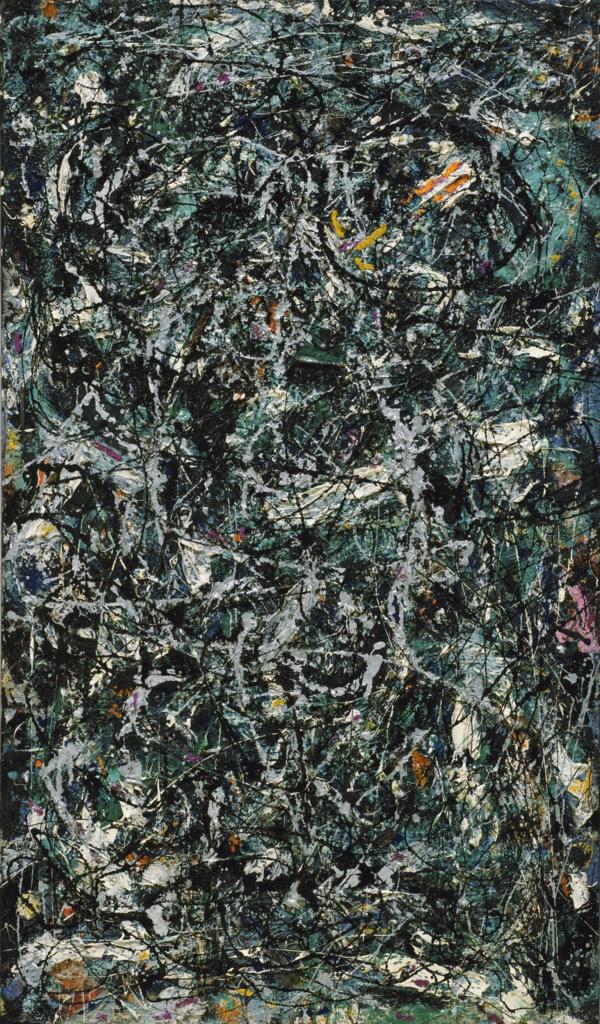
▲ "Man Wu Ying Xun" 1947/ Source: Network
Six, from "Abstraction and Empathy" into the palace of modern art.
Later, the development of European art proved the correctness of Wallinger’s theory, and modern art schools moved towards abstraction step by step, which in turn proved the greatness of Abstraction and Empathy. "Wallinger’s exposition of the principle of abstraction opened the door for modern art, and from then on, contemporary art boldly advanced along the road of abstraction and formalization," said Wang Caiyong.
Then, Mr. Wang simply combed the process of art’s development to abstraction. "Before the Second World War, cubism came first, which was an abstract pre-stage. It didn’t follow naturalism, so it could be said to be individualism. For example, we look at the cup as it is, but Picasso painted it in another way. This is how he perceives the world, and he expresses his interpretation of the world as an individual. This is actually a mirror, reflecting the universal existence in people’s hearts. Simply put, when we see something, it resonates. If we don’t use abstract expression and break through the’ form’, we can’t express what the artist thinks and our common resonance well. After the war, in the stage of contemporary art, artists were tired of individualism before the war. There is a subjective thing behind the personalized interpretation of artists before the war. By subjectivity, I mean that many individuals form a class. After the war, this concept was deconstructed and deconstruction rose. They think that individuals are still too heavy and too hard to carry the burden of’ one class’, so they pursue more thorough individuality. This trend is manifested in philosophy and art. "
However, "subject" and "individual" can not be completely separated, so Wang Caiyong said that there is still a problem of establishing a new subjectivity after deconstruction.
"In this way, we can understand many modern works of art, even some works that look unacceptable and disgusting, because it deconstructs our sympathetic subjectivity, but we have not yet established a new subjectivity. Any art, whether deconstructive or postmodern, is’ personal’ in creation, but what it wants to express must be supported by a specific group, not necessarily universal, but it must be universal. There are many situations in which there is a lack of universality in many contemporary arts. This can’t be entirely blamed on our contemporary artists, because compared with other arts, contemporary art has been difficult to establish a common position. On the one hand, he wants to be very’ individual’, which is his’ road’; On the other hand, he can’t imitate it like the Renaissance-just draw it like it. That is, contemporary art should not only adhere to personal tendencies, but also establish a new common orientation, and the result is narrower and narrower. "
Abstraction and Empathy, in a sense, has opened up a broader path for contemporary art to get out of the predicament and gain new development, that is, to enter modern art with abstraction as the main principle.
In fact, it is the same for us and contemporary society. At the forum of the publication of Art History and Philosophy, Wang proposed that "this era needs philosophy of art more". Academically, the core concepts of contemporary discussion art still need to be extracted from previous philosophy; In life, many people find art difficult to understand. How to enter art and aesthetics is the core goal of our discussion of art theory. Professor Wang Caiyong suggested:
1) read more books. If a foreign language is good, try to read the original text, overcome the variation caused by translation, and understand and grasp some terms in art.
2) Realize the connection and difference between art and philosophy. Philosophical words can be used to explain the theory of art history and literary criticism, but many times such explanations are not in place and will be misused. Art, art history and art philosophy have a sensible object; Philosophy is speculative and anti-time, and does not need specific objects. When "reading" a work of art, we should especially overcome ourselves. We should not pay attention to this work just because we like it, and say that it is not good if we don’t like it. Pay more attention to the works you don’t like, and calmly think about why there are such works.
Postscript
Wang Caiyong wrote at the end of the translator’s preface of Abstraction and Empathy, "As long as modern people’s sense of the world makes people have an abstract impulse all the time, Abstraction and Empathy will not lose its response". When we read literary theories and appreciate works of art, we can’t help but quote the following sentence: As long as we always have the impulse to express ourselves and the world, we won’t stop exploring the feelings, thoughts and resonance of people behind art.. In the end, what we know is not works or theories, or even art itself, but people’s heart and essence. In other words, real art and people’s life expression have never been far away.
Wechat editor Zhou Jielin
Editor-in-chief
Wonderful in the past
Original title: From Abstraction and Empathy to Modern Art

关于作者